
 AUS Stock - Local Delivery

Most growers think pollination is a dramatic event.
It usually isn’t.
There’s no explosion.
No instant disaster.
No overnight collapse.
The room still smells good.
The buds still swell.
The plants still look healthy.
That’s what makes it dangerous.
Pollination damage often appears slowly — and by the time growers realise what happened, the plant has already changed direction.
Because the moment pollen arrives, the plant’s priorities change permanently.
It starts chasing reproduction.
And that shift quietly changes everything:
- bud density
- resin output
- terpene progression
- stacking behaviour
- cannabinoid focus
- final smoke quality
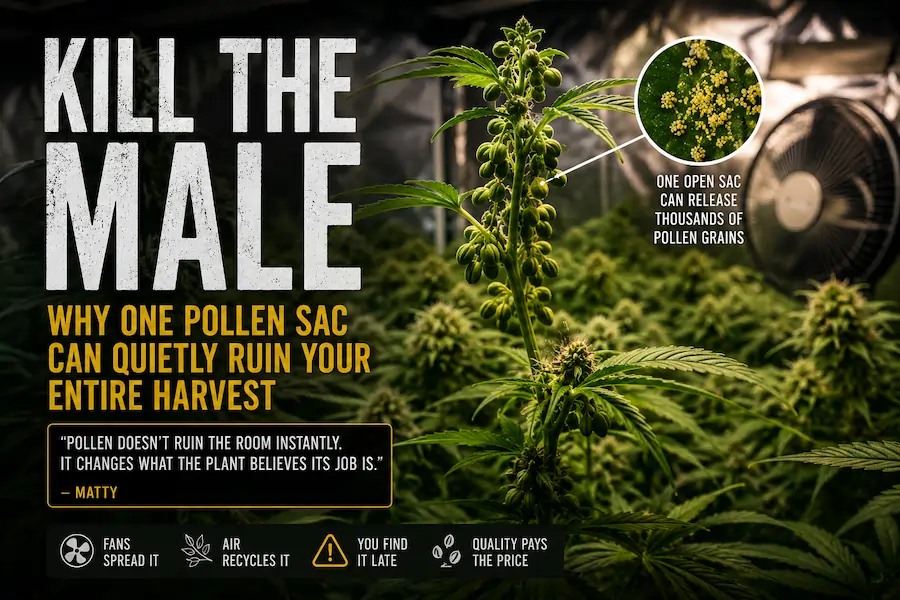
Matty: “Pollen doesn’t ruin the room instantly. It changes what the plant believes its job is.”
The Stabilising Truth Most Growers Miss
Female cannabis plants produce heavy resin because they are trying to attract pollen.
Once pollination happens, the biological objective changes.
The plant no longer prioritises:
- maximum terpene expression
- heavy resin output
- continued floral expansion
- aggressive cannabinoid production
Instead, energy begins shifting toward seed production and reproductive survival.
This is why seeded cannabis almost always feels:
- lighter
- hollower
- less sharp
- less resinous
- less emotionally complete
The THC may still test reasonably high.
The experience changes anyway.
Matty: “A pollinated plant keeps growing. It just stops growing for you.”
The Invisible Disaster
This is the part most growers misunderstand.
Pollen damage rarely looks catastrophic at first.
In fact, many pollinated plants still appear successful for weeks.
The buds continue swelling.
The canopy still looks healthy.
The room still smells loud.
That creates the false safety window.
The grower assumes:
“Looks fine.”
But internally, the plant already shifted direction.
The damage usually reveals itself later:
- random seeds appearing during trim
- reduced resin pressure
- lighter nug feel
- flattened terpene sharpness
- less “finished” effects after cure
Matty: “Pollination is one of the few disasters in cannabis where the room can still look successful while quality quietly collapses underneath.”
The Myth
“I only found one sac — I removed it in time.”
That is one of the most expensive assumptions in cultivation.
Growers imagine pollen spreads slowly.
Indoors, it often spreads almost instantly.
Especially when:
- oscillating fans are running
- inline extraction is active
- negative pressure is strong
- the canopy is dense
- humidity is low
One open pollen sac can release thousands of pollen grains.
And those grains are extremely light.
Airflow does the rest.
Outdoor pollen disperses into open space.
Indoor pollen gets recycled.
Inside a tent or sealed room:
- fans keep pollen suspended
- walls bounce airflow back into the canopy
- negative pressure pulls particles everywhere
- dense flower sites trap pollen internally
The longer a male or hermie remains in the room after sacs begin opening, the larger the contamination radius becomes.
And unfortunately, many growers discover the problem late:
- inside dense lower canopy zones
- under stressed branches
- near hidden interior nodes
- deep into flower
By that stage, the damage may already have spread beyond the visible sac.
Matty: “Growers think they’re fighting one plant. Half the time they’re fighting the ventilation system.”
The Difference Between a Male and a Hermie
Male Plant
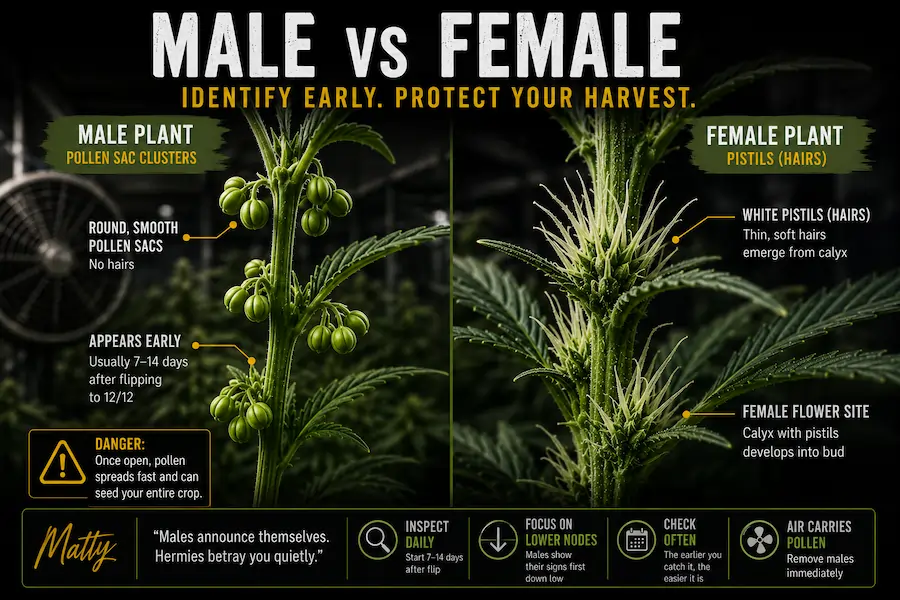
A true male plant develops pollen sacs exclusively.
No pistils.
No female flower sites.
Just reproductive pollen structures.
Most males reveal themselves during late veg or early flower transition.
Indoors, many plants show clear sex traits within 7–14 days after flipping to 12/12.
Pre-flowers usually appear at the nodes several days before mature sacs are ready to open.
The sacs usually appear as:
- small round balls
- smooth clusters
- tiny grape-like structures
No white hairs.
Hermaphrodite (“Hermie”)
Hermies are different.
These plants express both female and male reproductive traits simultaneously.
This often happens because of stress.
Common triggers:
- light leaks
- severe heat stress
- late-flower instability
- genetic instability
- aggressive pruning
- root-zone stress
- interrupted dark cycles
And this is where many growers get trapped:
Hermies often appear late.
Sometimes very late.
The plant already looks successful.
The room already smells incredible.
Then one hidden banana appears deep inside a cola.
Matty: “Males announce themselves. Hermies betray you quietly.”
The Banana Problem
Not all pollen structures look like round sacs.
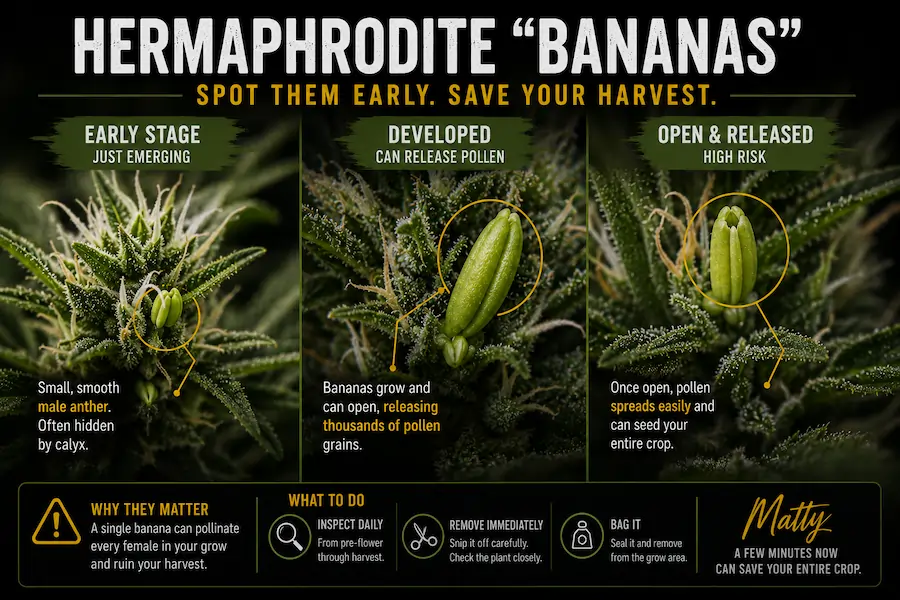
Late-flower hermies often produce what growers call “bananas” or “nanners.”
These usually look like small yellow or pale-green elongated structures emerging from between bract tissue.
They are thinner than normal calyxes, appear without pistils, and often look like tiny exposed anthers tucked inside the bud.
Unlike normal male sacs, bananas can release pollen almost immediately.
No swelling phase.
No warning.
That’s why late-flower hermies are so dangerous.
The pollen release window is much shorter.
Matty: “A banana doesn’t ask permission. It’s already open.”
How to Inspect Plants Properly
Most growers inspect the top canopy only.
That misses a huge percentage of problems.
Male structures and hermie sites commonly appear:
- inside lower canopy zones
- beneath dense fan leaves
- under stressed branches
- near interior nodes with poor airflow
The best inspection timing:
- right before lights-off
- early flower transition
- mid-flower stress periods
- after environmental swings
Use:
- a bright inspection light
- slow branch-by-branch checks
- daily scans during transition weeks
Matty: “Most growers don’t miss males because they’re hidden. They miss them because they stop looking after Week 3.”
What To Do If You Find a Male Plant
Move carefully.
Fast is good.
Violent is bad.
Step 1 — Turn Off Fans
Air movement spreads pollen immediately.
Kill oscillating fans before touching the plant.
Step 2 — Bag the Plant
Use a plastic bag to contain possible pollen movement.
Slide it gently from top to bottom.
Do not shake the canopy.
Step 3 — Cut Low and Remove Immediately
Cut the main stem near the base.
Keep the plant bagged while removing it from the room.
Do not carry exposed males through the grow area.
Step 4 — Inspect the Entire Room Again
Never assume one male is the only problem.
If one plant showed instability:
- reinspect everything
- especially lower canopy zones
- especially stressed branches
Matty: “The second male is usually the one growers miss because they relaxed after finding the first.”
What Pollinated Bud Actually Feels Like
Seeded flower usually reveals itself in four places:
- the buds feel lighter than expected
- the resin feels thinner
- the flavour loses sharpness after cure
- the effect feels incomplete underneath the THC
And this is important:
Pollinated cannabis can still look frosty.
It can still smell strong.
It can still test reasonably potent.
That’s why many growers misdiagnose the problem.
The issue is usually not total potency collapse.
It’s quality structure collapse.
Dense, resin-heavy strains like OG Kush or Gorilla Glue can still look impressive after pollination — but the jar usually tells the truth later.
Matty: “Seeded weed often feels like the skeleton of a great harvest.”
Why Feminized Seeds Changed Everything
Before feminized genetics became reliable, sexing plants was simply part of cultivation.
Growers expected losses.
Modern feminized cannabis seeds changed the entire workflow.
Good feminized genetics dramatically reduce:
- male plant risk
- space waste
- pollination disasters
- early culling pressure
But this is important:
Feminized does not mean invincible.
Bad stress management can still trigger hermaphroditic responses in unstable genetics.
That’s why environmental consistency still matters even with feminized seeds.
Matty: “Feminized seeds remove the lottery. They don’t remove the responsibility.”
The Real Lesson
This article isn’t really about killing males.
It’s about protecting momentum.
Because great cannabis depends on uninterrupted floral progression:
- stacking
- resin pressure
- terpene refinement
- cannabinoid development
- density formation
Pollination changes the direction of all of it.
Quietly.
And once that shift begins, the plant never fully returns to the same objective.
Memory Line: “The moment pollen lands, the plant stops chasing resin the same way.”