 AUS Stock - Local Delivery

G’day legends — Matty here.
The industry sold you a lie. They told you that autoflowers were the “beginner’s choice”—the low-stakes, set-and-forget entry point into cultivation. They told you they were forgiving because they don’t need a light cycle change.
That lie has wrecked more Aussie runs than spider mites ever will.
Photoperiods forgive. Autoflowers audit.
If a photoperiod is a long, slow conversation where you can take back a wrong word, an autoflower is a 70-day sprint where a single stumble costs you the podium. If you don’t have the discipline to stay calm, an auto will expose you faster than any plant on earth.
The Auto Clock: The Energy Debt No One Talks About
The fundamental misunderstanding of the autoflower is the concept of “recovery.”
In a photoperiod run, if you mess up the pH or over-veg, you simply add two weeks to the clock. You pay with time. But an autoflower has a fixed energy budget and a hard-coded deadline. She is going to flip to flower on Day 21–28 regardless of whether she’s six inches tall or two feet tall.
You don’t fix mistakes with autos — you reallocate failure.
Every cold morning, every soggy pot, every “panic flush” because you saw a spot isn’t just a setback; it’s a permanent withdrawal from her final jar. Stress doesn’t pause the clock; it just steals the energy she was supposed to use for resin production.
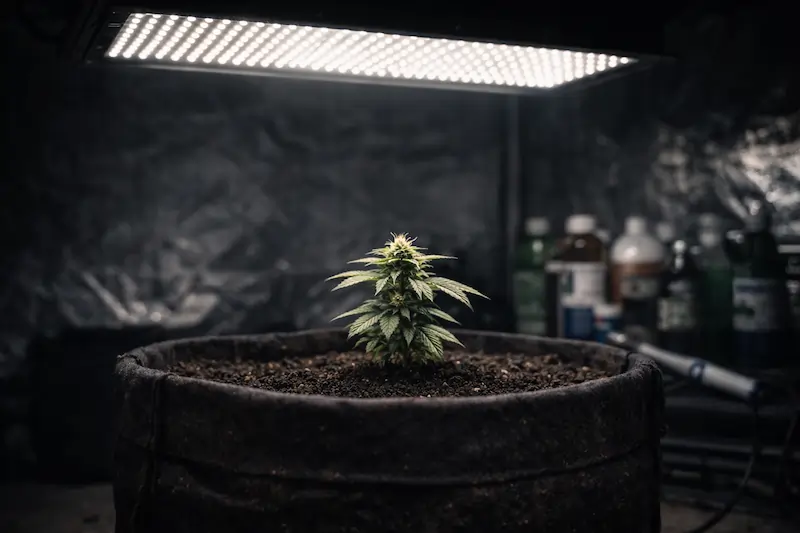
Why Calendars Lie: The Australian Ego Trap
I see it every year: growers planting by the calendar because “it’s nearly summer.” They think the sun is the only engine that matters.
The sun doesn’t grow your plant. The root zone does.
An auto doesn’t know it’s November in New South Wales or Victoria. It only knows its internal metabolism. If your root zone is cold and your media is saturated, your plant’s internal chemistry stalls. Her stomata slam shut to survive the VPD swing, and her growth stops.
The Three States of an Auto
We don’t look at “windows” of time. We look at Environmental States. Miss the first state, and the next two don’t matter.
- State I: The Ascending Thermal (The Glide) – This is about warming nights and predictable recovery. Floor of warmth is mandatory to keep metabolism moving.
- State II: The Peak Saturation (The Push) – Maximum light meets maximum demand. If you entered this state with an “Energy Debt” from State I, the plant will herm or fade prematurely.
- State III: The Precision Finish – This is the late-season play. It only works if you can hold a stable pH of 5.8–6.2 and keep root temps locked in while the world outside turns to shite.
The “Hope Grower” Exposed: The Purple Trap
I recently saw a grower chasing a “Purple” cultivar in a late-season auto run. Around Day 45, he saw a slight yellowing. Instead of trusting his environment, he panicked. He assumed a deficiency and jacked his feed, swinging his pH to 5.5 to “force” intake.
The result? He locked out his Phosphorus entirely. The plant turned purple, alright—but it wasn’t genetic expression. It was a death flare. By overcorrecting to save a leaf, he spent the last 20% of his energy budget on a metabolic heart attack. In the world of elite autos, there are no rescue arcs.
Who This Is For (And Who Should Walk Away)
Autoflowers are a mirror held up to your discipline. They are perfect for the Minimalist—the grower who can set a stable environment, log the data, and keep their hands in their pockets.
Autos are NOT for:
- The “Fixer” who needs to touch the plants daily.
- The “Fiddler” who changes light heights every six hours.
- The “Calendar Follower” who ignores the root zone.
The Verdict: If you can’t keep your environment stable and your ego in check for 21 days straight, don’t buy an auto. Buy a photoperiod. When you’ve developed the stones to do nothing, come back and try a sprint.
This is why we curate our genetics differently. Autoflowers don’t forgive optimism. They reward discipline.
— Matty
Too true mate I grow mine in a greenhouse in deep pots I’ve found they like a deeper pots compared to diameter size and I also grow and sew but the moon which sounds a bit hippy but the results speak for themselves
all good information. My plants and myself are in agreement.