 AUS Stock - Local Delivery

If you’re trying to diagnose a plant issue, this cannabis leaf symptoms chart will help you identify the most common cannabis leaf problems quickly.
If cannabis plants could talk, most growers would hear the same thing every week: “Something’s wrong down here.”
The good news? Cannabis already tells you exactly what’s happening — through its leaves.
Yellowing (chlorosis), brown spots (necrosis), curling edges, purple stems… these aren’t random cosmetic issues. They are diagnostic signals that reveal what is happening inside the plant’s environment, roots, and nutrient system.
This guide is your quick diagnostic command center. Instead of guessing, you can match what you see to the most likely cause and jump to the full guide explaining how to fix it.
If you want a full troubleshooting system for diagnosing plant issues step-by-step, see Matty’s complete guide here:
Cannabis Plant Problems: Matty’s Ultimate Troubleshooting Guide
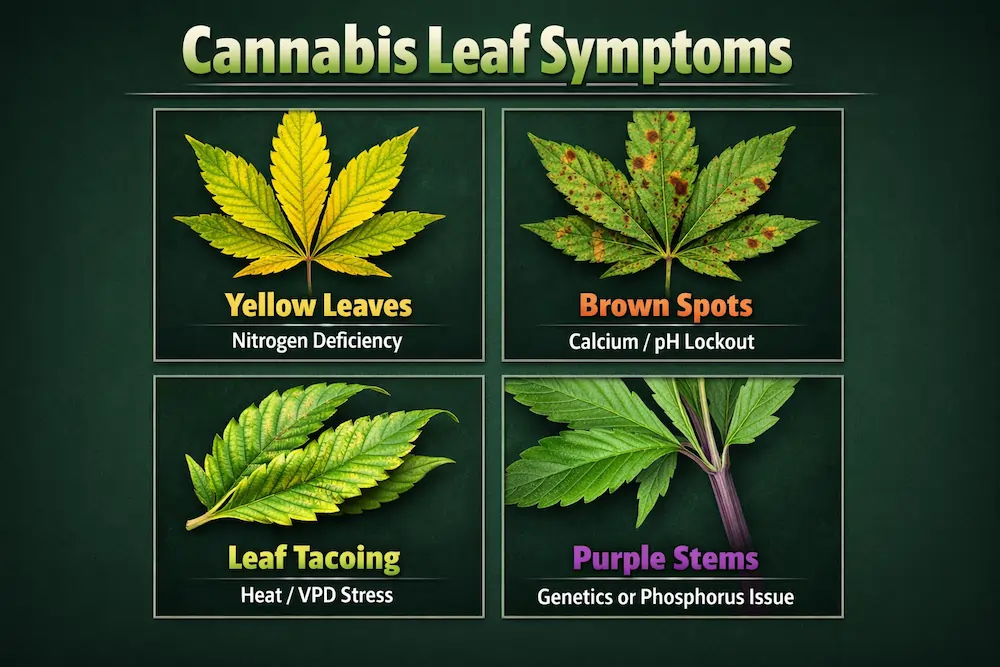
The Rapid Cannabis Leaf Symptom Matrix
| Leaf Symptom | Texture / Feel | Likely Cause | Next Step |
|---|---|---|---|
| Lower leaves yellowing | Soft or fading | Nitrogen deficiency or root stress | See Yellow Leaves guide |
| Rust or brown spots | Dry / necrotic patches | Calcium deficiency or pH lockout | See Brown Spots guide |
| Leaf edges curling upward | Crispy or thin | Heat stress or high VPD | See Curling Leaves guide |
| Leaves clawing downward | Thick and leathery | Nitrogen toxicity | See Curling Leaves guide |
| Purple stems or undersides | Normal leaf texture | Genetics, cold roots, or phosphorus lockout | Check temperature and pH |
| Leaves drooping but green | Limp / heavy | Overwatering or root oxygen issues | See advanced diagnostics |
The Pro Secret: Mobile vs Immobile Nutrients
This single concept prevents most misdiagnoses.
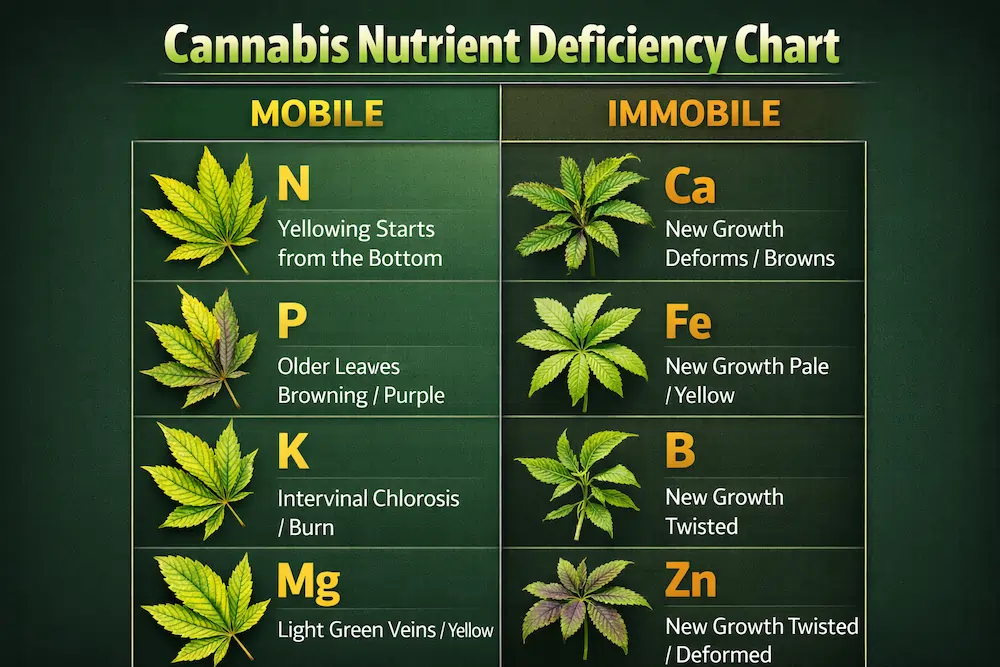
Mobile nutrients (Nitrogen, Phosphorus, Potassium, Magnesium) can move within the plant. When the plant is deficient, it steals nutrients from older leaves to feed new growth.
Read more: The Weird Cannabis Leaf Problems No One Tells You About
That’s why symptoms like nitrogen deficiency appear on the bottom of the plant first.
Immobile nutrients (Calcium, Iron, Boron) cannot move once deposited in tissue. When the plant cannot absorb them, symptoms appear in new growth first.
Matty’s rule: bottom leaves usually signal mobile nutrient issues. Top growth usually signals immobile nutrient issues.
The Elite Grower Touch Test
Observation alone isn’t enough. Professional growers use tactile feedback to diagnose plant stress.
- Crispy & thin leaves: VPD too high or light stress.
- Leathery, dark green leaves: nitrogen toxicity.
- Soft or limp leaves: root oxygen problems or overwatering.
If two symptoms look visually similar, the texture almost always reveals the real cause.
Yellow Cannabis Leaves
Yellowing (chlorosis) is one of the most common cannabis plant signals.
If yellowing begins on older leaves first, the plant is likely redistributing mobile nutrients like nitrogen to support new growth.
However, yellowing can also result from root stress such as overwatering, compacted soil, or pH imbalance preventing nutrient uptake.
Read the full Yellow Leaves guide →
Brown Spots on Cannabis Leaves
Rust or brown spots usually indicate a calcium uptake issue.
However, elite growers know that calcium problems are often caused by nutrient antagonism.
Excess potassium (K) or magnesium (Mg) can block calcium absorption even when calcium is present in the feed.
Modern LED grows increase calcium demand because faster growth requires stronger cell walls.
Read the full Brown Spots guide →
Cannabis Leaves Curling Up or Down
Leaf curvature often indicates environmental stress.
Upward curling (“tacoing”) usually means excessive transpiration caused by heat or high vapor pressure deficit (VPD).
Modern LED grows should measure Leaf Surface Temperature (LST) using an infrared thermometer.
If leaf temperature is 3–4°C higher than ambient air, the plant will curl its leaves to reduce water loss.
Downward clawing usually signals nitrogen toxicity or excessive nutrient levels.
Read the full Curling Leaves guide →
Purple Leaves and Stems: Quick Decision Guide
- Purple stems only: often genetics or temperature related.
- Purple undersides with slow growth: possible phosphorus deficiency.
- Purple coloration spreading through leaves: potential cold root zone or nutrient lockout.
Phosphorus lockout commonly occurs when soil pH drops below 6.0.
Always verify pH before adjusting nutrients.
If you’re specifically trying to grow purple cannabis intentionally, read Matty’s Guide to Purple Cannabis.
Matty’s Grower Triage Protocol
Before touching nutrient bottles, work through this diagnostic hierarchy:
- The Environment: check temperature, humidity, and VPD.
- The Medium: test pH and electrical conductivity (EC).
- The Roots: confirm good oxygen and drainage.
- The Feed: review nutrient balance and strength.
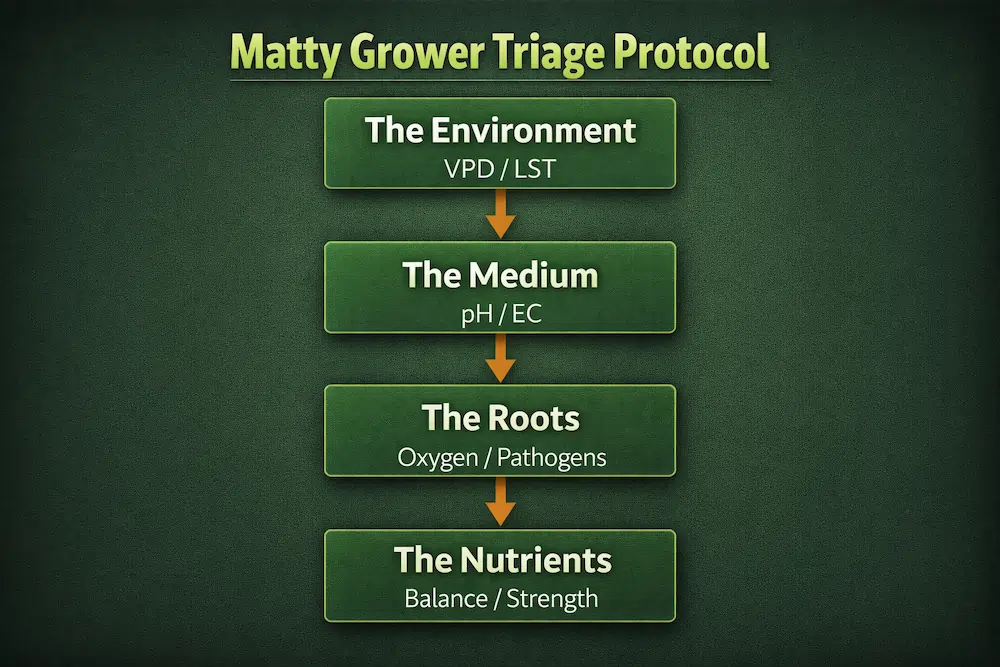
Fixing the environment often solves problems faster than changing the feeding schedule.
The Grower Logbook Habit
Elite growers track data.
Whenever symptoms appear, record:
- Date
- Observed symptom
- Runoff pH
- Runoff EC
This habit prevents guesswork and helps identify patterns across multiple grows.
Case Study: The “Rusty” Top Growth
A grower once contacted Matty about what looked like a fungal infection causing brown spots across the canopy.
After testing runoff, the root zone pH measured 5.2 in coco. Calcium uptake had completely collapsed.
After correcting the pH to 6.1, new growth returned healthy within days.
The fungus never existed.
Environment and chemistry beat biology nine times out of ten.
Final Thoughts
Once you learn how to read cannabis leaves, growing becomes far less mysterious.
Yellowing, curling, spotting, purpling — it’s not random. It’s information.
Listen to the plant, diagnose systematically, and correct the root cause.
Because in the grow room, the leaves never lie.
Awesome work Bro, ive learned so much reading your blog, and it all makes sense, your a Pot Guru