 AUS Stock - Local Delivery

If you’ve been searching for why cannabis leaves curl up or down, the answer usually comes down to two things: the shape of the curl and where it appears on the plant.
One of the quickest ways to send a grower into panic mode is seeing leaves suddenly folding, clawing, or twisting.
But here’s the truth: leaf curl is one of the clearest diagnostic signals a cannabis plant can give you.
Once you learn to read the plant properly, those curled leaves stop being scary and start becoming useful clues.
If you’re working through multiple symptoms or want a broader troubleshooting framework, start with the full cannabis troubleshooting guide. It walks through how experienced growers diagnose issues step by step instead of guessing.
In this guide, I’ll show you how I diagnose curling leaves in the grow room using the same logic experienced growers use to troubleshoot a crop.
— Matty
Matty’s Grow Room Field Manual
Cannabis Leaf Curl Diagnostic Framework
“Stop guessing. Curled leaves aren’t a problem; they’re a data stream. Once you learn to decode the shape, texture, and colour, the solution gets much simpler.” — Matty
Rapid Diagnostic Matrix
| Leaf Presentation | Likely Stressor | Primary Action |
|---|---|---|
| Upward “Tacoing” | High VPD / Light Saturation | Raise humidity slightly or reduce light intensity |
| Downward “Clawing” | Nitrogen Toxicity / Root Anoxia | Reduce feed strength and allow proper dry-back |
| Twisted New Growth | pH Instability / Calcium Lockout | Check root-zone pH and calcium availability |
| Clawing + Purple Stems | Acid-Induced Phosphorus Lockout | Lift pH toward the upper end of the target range |
The Elite Touch Test
Professionals don’t just look at curled leaves. They feel them.
- Crispy and thin: low humidity, high VPD, or light stress
- Leathery and rigid: nitrogen toxicity or overfeeding
- Soft and limp: overwatering, root stress, or early root-zone trouble
Matty’s Fast Rule: Read the Shape First
When leaves curl, the shape usually gives away the category of problem before anything else does.
- Upward curl usually points to heat, light, dry air, or a plant losing water too fast.
- Downward clawing usually points to too much nitrogen, overwatering, or root-zone stress.
- Twisting or warped new growth usually points to calcium problems, pH lockout, or environmental shock.
Matty’s grower rule: if the curl shape makes sense, the diagnosis usually follows.
The Three Main Types of Cannabis Leaf Curl
1. Upward Curl (Taco / Canoe Leaves)
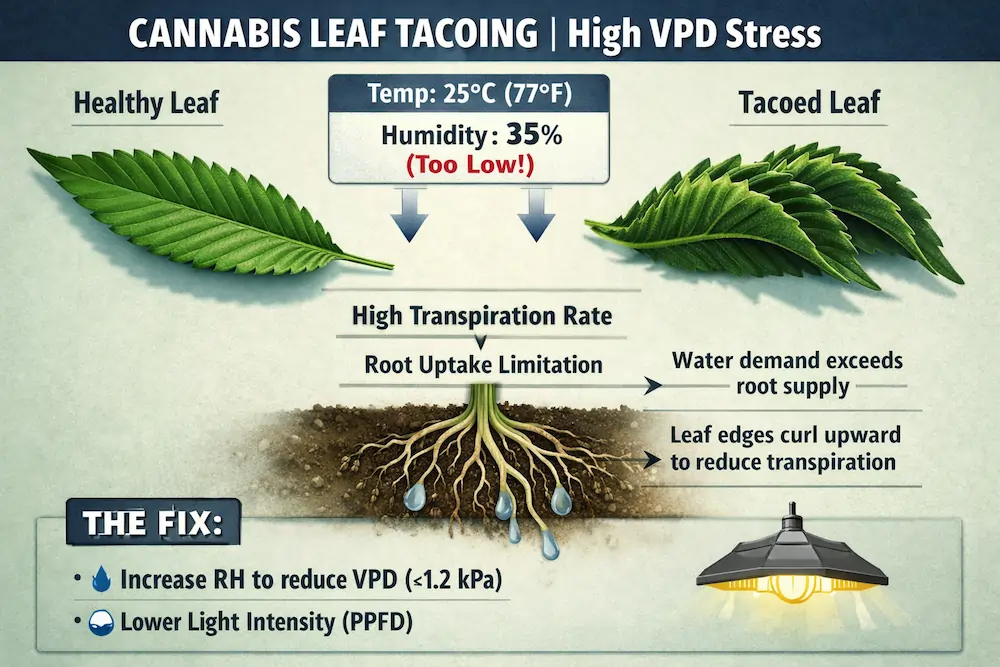
The leaf edges curl upward toward the middle, giving the leaf a taco or canoe shape.
This usually means the plant is trying to reduce water loss and protect itself from excessive transpiration.
Common triggers include:
- Excess heat
- Low humidity
- Grow lights that are too intense or too close
- Roots that can’t keep up with the demand above ground
2. Downward Curl (The “Claw”)
This is when the leaf tips hook downward like talons.
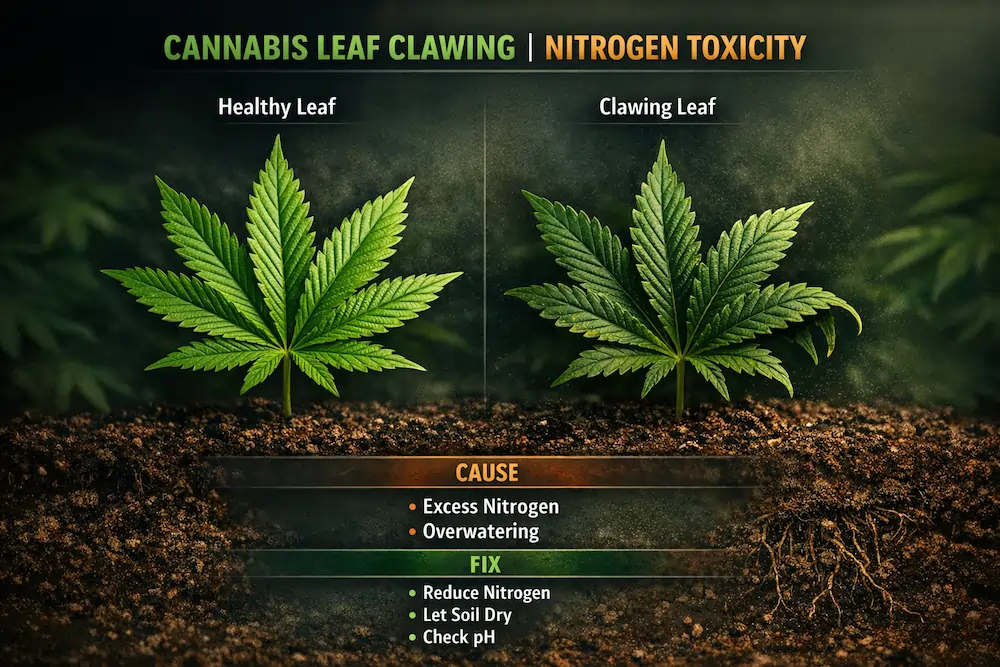
Growers often assume this means deficiency, but most of the time it’s a sign of excess or root-zone stress.
Common causes include:
- Nitrogen toxicity
- Overwatering
- Salt buildup in the medium
- General root stress
3. Twisted or Warped Leaves
Sometimes the leaves don’t curl neatly up or down. They come out twisted, crinkled, cupped, or misshapen.
That usually points to:
- Calcium deficiency
- pH lockout
- Environmental instability
- Less commonly, pest or pathogen issues
Twisted or warped new growth is one of the few cases where environmental stress and nutrient issues overlap. Calcium problems, pH lockout, and root-zone instability can all produce very similar-looking symptoms at the top of the plant.
If the pattern isn’t clear, use the leaf symptom comparison chart to compare how these issues typically show up and where they start. It can help separate a true deficiency from a delivery problem.
Why Cannabis Leaves Curl Up (Taco Leaves)
When leaves curl upward, it usually means the plant is trying to slow transpiration.
Think of it as the plant’s version of squinting in harsh conditions.
Heat Stress
Cannabis usually performs best when canopy temperatures stay around 24–28°C.
If the canopy gets too hot, leaves may curl upward to reduce surface exposure and slow water loss.
Low Humidity
If the air is too dry, the plant may lose water faster than the roots can replace it.
Good target ranges are:
- Vegetative stage: 55–70% RH
- Flowering stage: 40–55% RH
When humidity drops too low, tacoing often follows.
Too Much Light
Modern LEDs can push a lot of intensity. If they’re too close to the canopy, upper leaves may curl upward to protect themselves.
As a general guide:
- Vegetative stage: keep LEDs about 45–60 cm away
- Flowering stage: keep them about 30–45 cm away, depending on fixture strength
High VPD / Fast Transpiration
Sometimes the room isn’t technically “too hot,” but the vapor pressure deficit (VPD) is too aggressive.
That means the air is pulling water from the plant faster than the roots can supply it. The result is often the same: taco leaves.
This is especially common under strong LEDs where leaf metabolism ramps up hard.
Matty’s masterclass: if the room is sitting at 24–25°C but humidity is down around 30–35%, the air can still be far too thirsty. That’s when the plant starts curling up to “close shop.”
Roots Can’t Keep Up
This shows up a lot in fast-growing plants, small pots, or root-bound containers.
If the top half of the plant is expanding quickly but the roots haven’t caught up, the leaves may curl upward as a protective move.
Matty’s tip: if you’ve got taco leaves on a vigorous plant in a small pot, don’t overthink it. Check the root zone before you start blaming mystery deficiencies.
Why Cannabis Leaves Curl Down (The Claw)
Downward curling is one of the most commonly misread leaf signals in cannabis.
Most of the time, clawing is not the plant asking for more food. It’s the plant telling you it’s had too much — or that the roots are unhappy.
Nitrogen Toxicity
This is the classic cause of clawing.
Signs usually include:
- Very dark green leaves
- A slightly glossy or heavy look
- Tips curling downward like hooks
Too much nitrogen makes the leaves look overfed, thick, and tense.
Matty’s rule: if the leaf is dark, shiny, and clawed, think excess before deficiency.
Overwatering
Overwatering is usually about frequency, not volume.
If the medium stays wet too often, the roots struggle for oxygen, and the leaves start drooping and curling.
The Turgor Test
This is one of the simplest pro tricks for reading curled leaves properly.
- Firm, heavy, clawed leaves usually point to toxicity or overwatering.
- Soft, limp, wilted leaves usually point to underwatering or severe root stress.
Leaf posture tells you a lot. So does leaf texture.
Matty’s tip: don’t just look at the curl — touch the leaf. A rigid claw tells a different story than a limp one.
Salt Buildup
In coco, hydro, or heavy-feed soil grows, excess salts can build up in the root zone and create clawing, tip burn, and general stress.
If runoff EC is high and the plant is clawing, a reset may be needed.
The Purple Stem Signal
Sometimes clawing shows up alongside purple stems or purple leaf petioles.
That’s a clue many growers miss.
Excess nitrogen can acidify the medium over time. When the root zone drops too low, phosphorus becomes less available.
The result can look like two problems at once:
- Clawing from nitrogen excess
- Purple stems from phosphorus lockout
Matty’s masterclass: when you see clawing and purple stems together, don’t just blame genetics. Check the root-zone pH before you do anything else.
Twisted or Warped Cannabis Leaves
If new growth comes in twisted, misshapen, crinkled, or oddly curled, the issue is usually different from heat tacoing or nitrogen clawing.
Calcium Deficiency
Calcium helps build strong cell walls and healthy new tissue.
Because calcium is an immobile nutrient, deficiencies appear in the newest growth first.
Common symptoms include:
- Twisted or crinkled new leaves
- Uneven leaf shape
- Weak, irregular development at the top of the plant
pH Lockout
Sometimes calcium is present, but the plant still can’t use it because the pH is out of range.
Good targets are:
- Soil: 6.2–6.7
- Coco / Hydro: 5.8–6.2
If the pH drifts badly, new growth can come out twisted or distorted even though the feed schedule looks fine on paper.
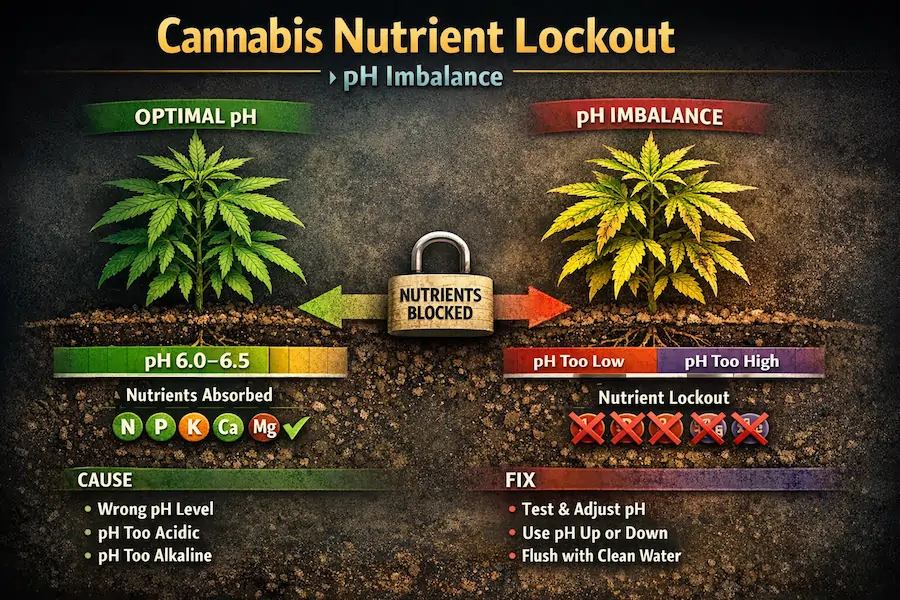
Matty’s tip: when the top leaves look weird and nothing else makes sense, check pH before you go shopping for another bottle.
Actionable pH Targets
Checking pH is good. Correcting it strategically is better.
- If you see clawing + purple stems in soil, steer irrigation toward 6.4–6.6 to help unlock phosphorus.
- If you see twisted new growth in coco, make sure you are not dipping below 5.8, where calcium uptake drops off quickly.
The Buffer Reset (3× Volume Rule)
When leaf curl is widespread and the root zone is clearly out of balance, don’t chase five separate deficiencies.
Reset the medium properly.
The standard approach is the 3× volume rule.
That means running roughly three times the pot’s volume of pH-stable, low-EC water through the container.
Example: a 10-litre pot gets about 30 litres of properly adjusted water.
The goal is to wash out excess salts, stabilize the buffer, and bring the root zone back into a usable range.
Important: finish with a light ¼-strength nutrient feed to re-prime the medium so the plant doesn’t go from toxicity straight into starvation.
Matty’s 3-Minute Curl Diagnosis
When someone sends me photos of curling leaves, I usually run through the same quick checklist.
1. Check Where It Starts
- Top canopy first → heat, light, low humidity, calcium, iron, sulfur
- Lower leaves first → nitrogen, magnesium, potassium, watering, root zone
2. Check the Colour
- Dark green + clawing → toxicity
- Pale or yellow + curl → deficiency or root stress
3. Check the Texture
- Crispy and thin → dry air, VPD, light stress
- Leathery and rigid → nitrogen toxicity
- Soft and limp → watering or root issue
4. Check Pot Weight and Moisture
If the pot still feels heavy, don’t add more water just because the leaves look sad.
5. Check pH and Feed Strength
If multiple symptoms are showing up at once, root-zone chemistry is often the real issue.
When Leaf Curling Isn’t Actually a Big Problem
Not every curl means you’re on the edge of disaster.
Slight curling can happen during:
- Rapid vegetative growth
- Hot outdoor afternoons
- Minor short-term environmental swings
If the new growth is otherwise healthy and the plant keeps moving, a little curl may correct itself once conditions settle down.
A Real Grow Room Story
A grower once sent me photos of twisted, clawed leaves and was convinced he had a virus.
He was ready to start spraying everything in sight.
I checked the runoff pH first.
It was sitting at 5.2.
The plant wasn’t infected. It was starving in an acidic medium.
We did a full 3× reset, brought the root zone back to the right range, and within five days the new growth came in clean and normal.
Matty’s takeaway: in most grow rooms, environment and chemistry beat biology nine times out of ten.
More Cannabis Leaf Troubleshooting Guides
If you’re diagnosing plant problems, these guides will help too:
- Why Cannabis Leaves Turn Yellow
- Brown Spots on Cannabis Leaves
- Beginner’s Guide to Growing Cannabis in Australia
Frequently Asked Questions
Final Thoughts
Cannabis leaves don’t curl for no reason.
When they start folding, clawing, or twisting, the plant is reacting to something real in its environment or root zone.
That’s the good news, really. It means the plant is giving you clues.
If you slow down, read the shape properly, and work through the obvious causes first, you’ll usually solve the issue faster than you think.
Most of the time, the answer isn’t complicated. It just looks dramatic.
— Matty