 AUS Stock - Local Delivery

If you’re searching for a cannabis nutrient deficiency chart, what you actually need is a way to read the plant properly. Not just spot a colour and match it to a list—but understand where the system is breaking down.
Think of it like this: Environment > Roots > pH > Nutrients
This guide is built like a field reference. Use the chart to get close. Use the logic below to get it right.
How to Use This Nutrient Deficiency Chart
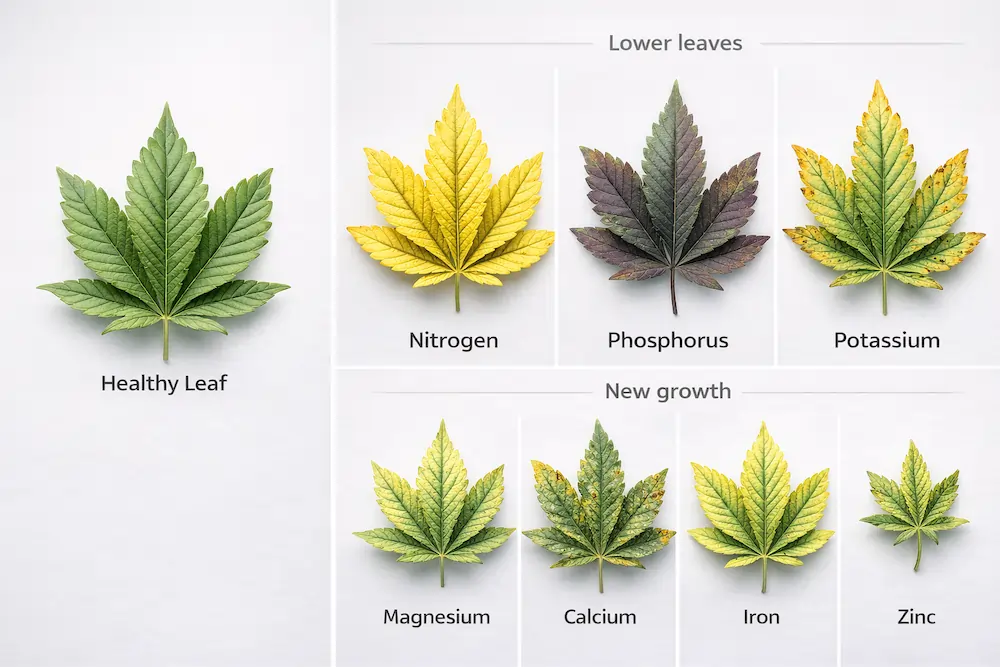
“If a chart gets you looking in the right place, it’s doing its job. The plant will tell you the rest.” — Matty
The chart gives you a fast visual read based on three things:
- Where symptoms start (top vs bottom)
- What they look like (pattern, colour, progression)
- Which nutrient is most likely involved
But plants don’t read charts.
In a real grow, you’ll often see multiple patterns overlapping. That’s where most misdiagnosis happens.
Leaves are the signal—not the cause. Before adjusting nutrients, run through:
- Is the environment stable (VPD, light, airflow)?
- Are the roots active and oxygenated?
- Is pH allowing uptake?
Most “deficiencies” are not missing nutrients—they’re nutrients that can’t move.
The Mobile vs Immobile Nutrient Framework
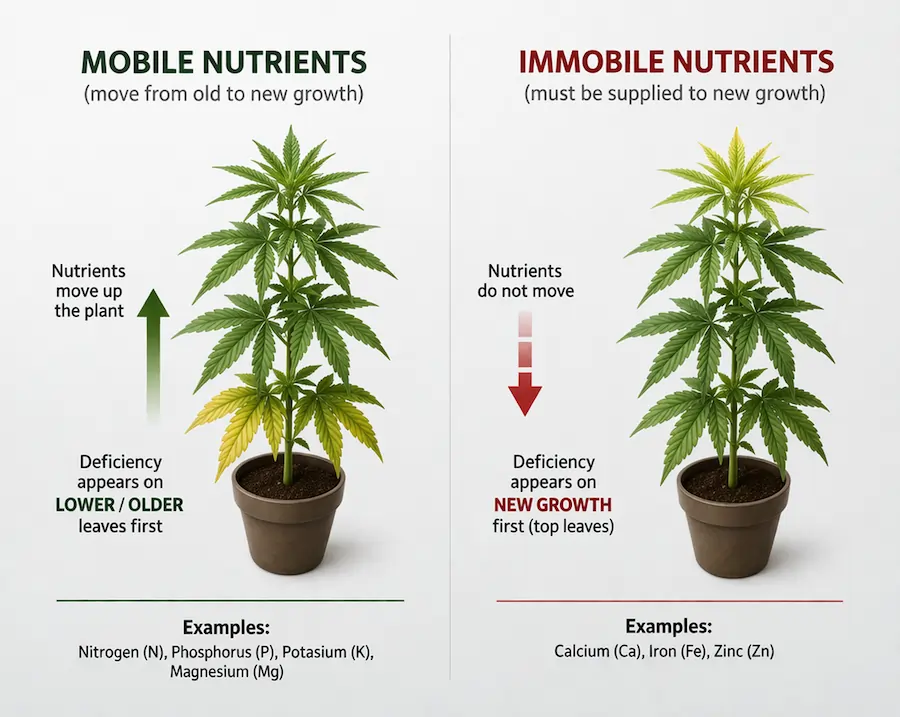
“Bottom issues mean the plant’s borrowing from itself. Top issues mean it’s not getting what it needs.” — Matty
This is the fastest way to narrow things down.
Mobile Nutrients
Nitrogen, phosphorus, potassium, and magnesium can be relocated. When supply is limited, the plant pulls from older leaves.
Result: Symptoms start at the bottom.
Immobile Nutrients
Calcium, iron, zinc, manganese, and sulfur rely entirely on new uptake.
Result: Symptoms appear at the top.
Bottom = redistribution problem. Top = delivery problem.
Macronutrient Deficiencies
Nitrogen (N)
Where it appears: Lower leaves
Symptoms:
- Uniform yellowing
- Older leaves fade and drop
- Overall pale plant
Fingerprint: Whole leaf yellows from the bottom up.
Quick fix:
Increase feed slightly, but check root saturation first. Nitrogen is often present—it’s just not being taken up.
Phosphorus (P)
Where it appears: Lower to mid leaves
Symptoms:
- Dark, sometimes bluish foliage
- Purple stems
- Slow development
Common trigger: Cold root zone
If your pots are sitting below ~18°C (64°F), phosphorus uptake slows dramatically. This is a physical bottleneck, not a feeding issue.
Pro tip:
If the stem is purple only on the light-facing side, it’s often genetic or UV response. If it’s fully purple with red petioles, look at phosphorus and root temperature.
Quick fix:
Warm the root zone before adjusting nutrients.
Potassium (K)
Where it appears: Lower and mid leaves
Symptoms:
- Leaf edge burn
- Yellowing margins
- Weak structure
The K–Ca–Mg Triangle:
These three compete constantly. If potassium is high, it can block magnesium and calcium—even when they’re present.
Quick fix:
If EC is high or ratios are off, reset before adding more. When potassium looks low, it’s often being pushed out of balance.
Secondary Nutrient Deficiencies
Calcium (Ca)
Where it appears: New growth
Symptoms:
- Twisted leaves
- Rusty spots
- Weak tissue
Key concept: Transpiration pull
Calcium moves with water. If humidity is too high and transpiration drops, calcium stops moving—even if your reservoir is perfect.
Quick fix:
Fix airflow and VPD before increasing calcium.
Magnesium (Mg)
Where it appears: Lower leaves
Symptoms:
- Interveinal chlorosis
- Veins stay green
Fingerprint: Green veins, yellowing between them (lower leaves).
The K–Ca–Mg Triangle:
Excess potassium or calcium can block magnesium uptake. Adding more Mg won’t fix a ratio problem.
Overlooked trigger: Dry media
When your medium dries out too much, salt concentration spikes quickly. Magnesium is often the first to get pushed out of reach.
Quick fix:
Keep a consistent wet-dry cycle. Don’t let pots get excessively light before watering.
Sulfur (S)
Where it appears: New growth
Symptoms:
- Uniform pale green leaves
Fingerprint: Whole top leaf turns lime green (not just between veins).
Micronutrient Deficiencies
Iron (Fe)
Where it appears: New growth
Symptoms:
- Yellow tissue with green veins
Fingerprint: Green veins, yellow leaf (top growth).
Quick fix:
Correct pH first. Iron is usually there—it’s just locked behind the wrong pH.
Zinc (Zn)
Symptoms:
- Small, distorted leaves
- Tight node spacing
Manganese (Mn)
Symptoms:
- Chlorosis with small necrotic spots
Common Misdiagnoses
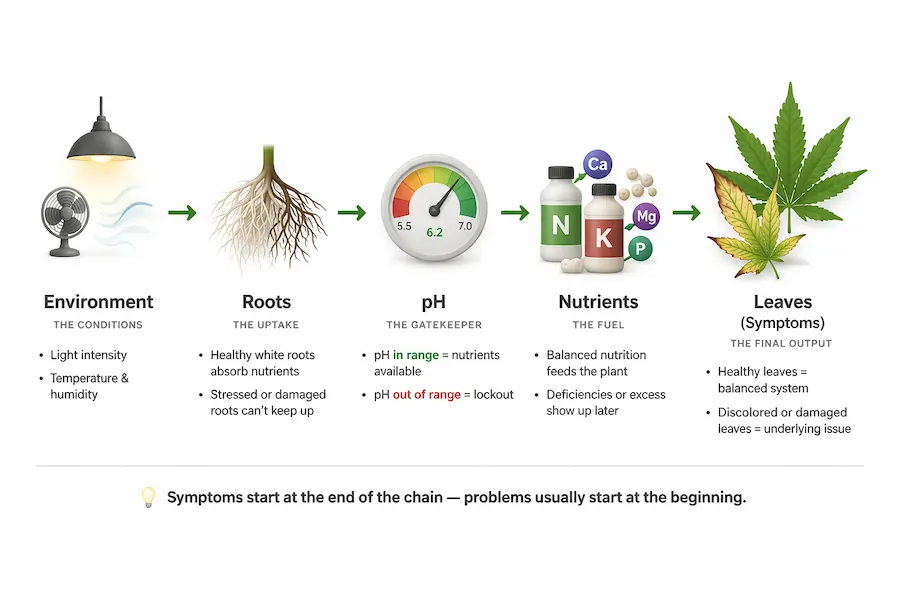
“Good growers react. Great growers trace it back.” — Matty
pH Lockout vs Deficiency
Think of pH as the doorway. If it’s off, nutrients can’t enter the plant—no matter how much is available.
Overfeeding vs Deficiency
High EC can block uptake and create false deficiencies.
Root Collapse
If everything looks wrong at once, it usually is. That points to roots or environment—not nutrients.
Note on Recovery
Damaged leaves rarely recover. Focus on new growth. If new leaves come in healthy, the issue is fixed—even if old leaves stay yellow.
Matty’s Diagnostic Tip
“I don’t chase nutrients—I track movement. Water, air, and uptake. When something stops moving, the plant tells you.”
Field Report
I once walked into a room full of what looked like zinc deficiency—twisted, thin new growth everywhere. The grower was ready to switch nutrient lines.
Turns out the lights were too close. High-intensity LEDs, no CO₂, about 30cm off the canopy. The plants were stressed, not deficient.
We raised the lights. Three days later, the “deficiency” was gone.
Always rule out the environment before blaming the nutrients.