 AUS Stock - Local Delivery

By Matty Ridge
If you’re still obsessing over THC percentages, you’re not in the elite. You’re stuck in The Terpene Trap, and it’s costing you flavour, aroma, and most importantly, your reputation. The entire industry is chasing a flawed metric designed by amateur chemists, not master cultivators.
This doctrine is simple: Forget THC. Focus on Aw (Water Activity).
We are rewriting the rules of curing. If you want the kind of flower that truly separates itself from the worldwide market—the kind that makes jaws drop—you need to shift your focus from what you have (THC) to how you keep it (terpenes).
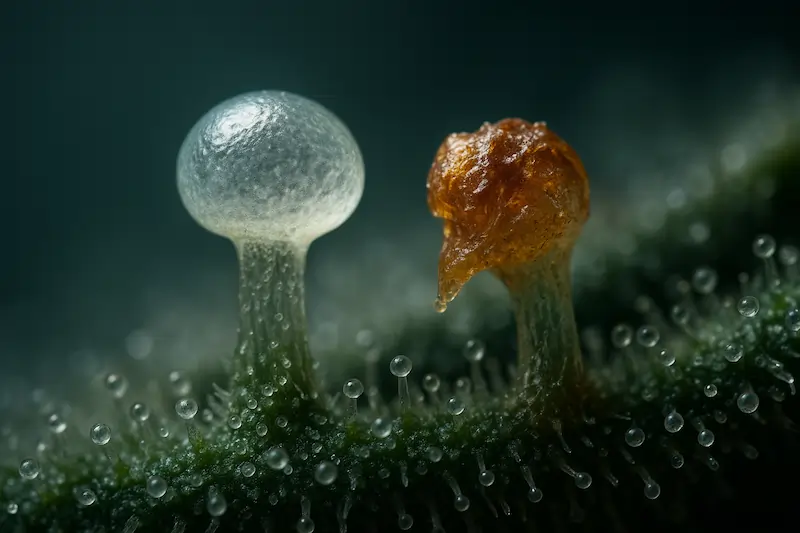
1. The Terpene Trap: A Lie You Were Sold
For decades, the industry narrative has been this: higher THC equals better quality. It’s simple, marketable, and completely, scientifically false.
The Reality Check:
- Terpenes are the Experience: The entourage effect, the strain-specific aroma, the smooth smoke—it’s all driven by volatile terpenes. THC is the engine, but terpenes are the fuel, the transmission, and the spoiler.
- The Volatility Problem: Terpenes are highly volatile. They are the first compounds to break down, evaporate, or convert when exposed to incorrect drying and curing conditions.
- THC is Stable: THC is robust. It’s difficult to destroy during the average curing process. A high THC result often just means you had high THC before you ruined the terpenes through improper drying. You successfully maintained the engine while setting the rest of the car on fire.
The Terpene Trap is the idea that high THC proves success. All it proves is that you didn’t destroy the main cannabinoid. True elite curing is about preservation, not just retention.
2. The Only Metric That Matters: Water Activity (Aw)
Stop checking humidity (Relative Humidity or RH). RH is an environmental metric. You need to measure the product metric: Water Activity (Aw).
Aw is the single most accurate scientific predictor of shelf life, terpene degradation, and most critically, microbial stability (mould, yeast, bacteria).
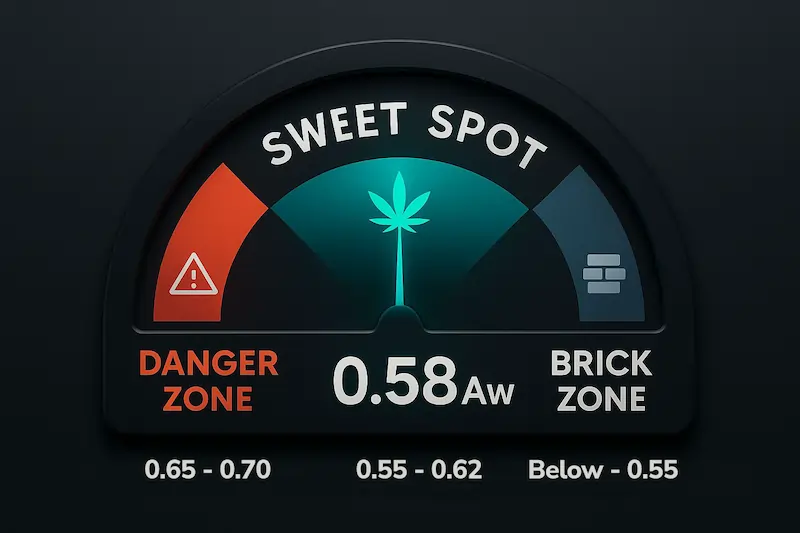
| Aw Range | Description | Result |
|---|---|---|
| 0.65 – 0.70 | The Danger Zone | Mould risk is high. Accelerated terpene loss. Crunchy, dry, ruined flower. |
| 0.55 – 0.62 | The Sweet Spot | Elite Curing Range. Maximum terpene preservation, perfect microbial stability, smooth smoke. |
| Below 0.55 | The Brick Zone | Overly dry. Maximum loss of volatile terpenes. Harsh smoke, stale aroma, zero bag appeal. |
The Ridgey-Didge Conclusion: You cannot achieve world-elite status without measuring Aw. It’s non-negotiable.
Why Water Activity (Aw) is the Future of Curing
3. The Ridgey-Didge 3-Step Curing Doctrine
This is the system the elite use to consistently hit the Aw Sweet Spot and lock in those precious volatile oils.
Step 1: The Pre-Cure Stabilization (The Slow Dry)
This is where 90% of growers lose 50% of their terpenes. You need to maximize the initial dry time to allow the plant material to stabilize gradually.
- Temperature: 18°C – 20°C (64°F – 68°F)
- Humidity: 55% – 60% RH
- Goal: Slow the initial drying rate down to 1-2 weeks. Use dehumidification or air conditioning to hit these numbers reliably. The longer the initial dry, the slower the conversion and breakdown, and the more terpenes are preserved.
Step 2: Hit the Aw Sweet Spot (The Science)
Once the material is dry to the touch but still springy, it’s time to move into containers for the critical Aw cure.
- The Move: Transfer the flower into airtight containers (glass jars, heavy-duty buckets).
- The Check: After 24 hours, measure the Aw.
- If it’s above 0.65 Aw, the flower is still too wet. Leave the container lid off for 1-4 hours and re-check.
- If it’s below 0.55 Aw, you have over-dried. You can use humidity packs, but the damage to volatile terpenes is often irreversible. Your goal is always to land directly in the sweet spot.
- The Final Sweet Spot: The curing environment (your jar/container) must maintain the flower at 0.58 Aw (± 0.02) for a minimum of 3-4 weeks. This allows for controlled, micro-level breakdown of chlorophyll and sugars without excessive terpene loss.
Step 3: Terpene Lock-Down (The Finish)
Once your flower has stabilized within the Sweet Spot (Aw 0.55-0.62) for a full month, the cure is finished.
- Storage: Store in a cool (below 15°C / 59°F), dark, and airtight environment. The lower temperature dramatically slows down the ongoing terpene degradation, effectively “locking in” the profile you worked so hard to achieve.
- Never Vacuum Seal: Vacuum sealing compresses the delicate flower structures, crushing glands and releasing volatile terpenes prematurely. Use a nitrogen-flushed environment if possible, but an airtight container is sufficient for elite results.
The Verdict
The Aw Doctrine is the only way forward. The THC chase is a dead end—a marketing gimmick. If you adopt this scientific approach, you stop leaving half your product’s value in the drying room.
Go and get yourself an Aw meter. Then come back and tell me your flower isn’t world-elite.