
 AUS Stock - Local Delivery

The truth most growers learn too late: autoflowers run on a clock. From the moment that seed pops, you’ve got about 2–3 weeks of real growth before flowering kicks in.
If your soil is too heavy, too hot, or too wet during that window — you don’t recover it.
Autos don’t give second chances — they just give smaller plants.
Matty here.
I’ve seen more autos ruined by “premium” hardware store soil than anything else. Not lights. Not nutrients. Soil.
You get one clean run at those first weeks — and that’s what decides your final yield.
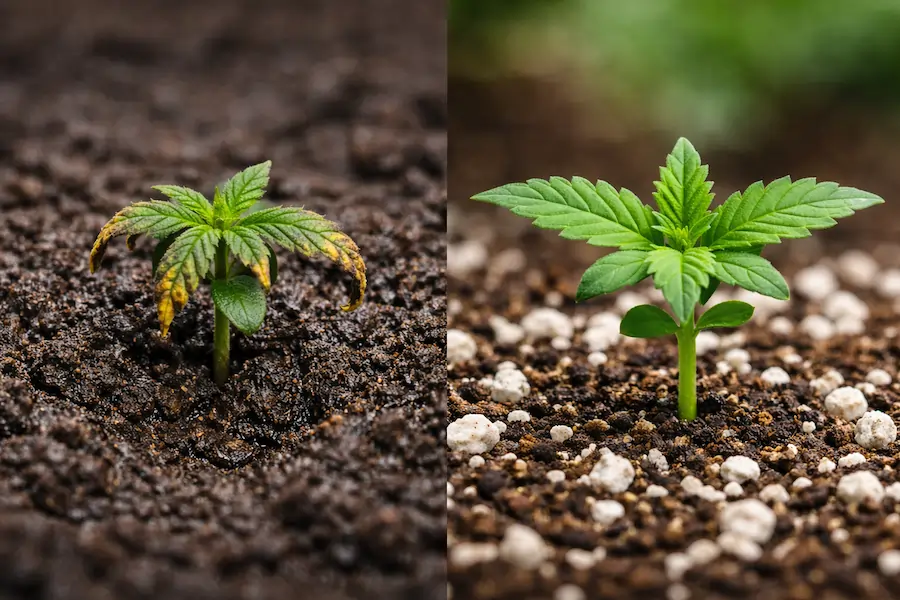
Matty’s Law: Root Momentum Is Everything
Autoflowers don’t want rich soil — they want oxygen and movement.
If roots struggle early, the plant slows down. And once it slows down, that size is locked in.
- Too heavy? Roots struggle → slow growth
- Too hot? Seedlings burn → permanent stunting
- Poor aeration? Weak roots → small plants
Early momentum = final size.
The False Recovery Trap
Here’s the cruel bit with autoflowers: they often look like they recovered.
The leaves perk back up.
New growth appears healthy.
The plant starts moving again.
But the clock never stopped.
If an autoflower loses 4–5 critical days in the first three weeks, it may recover visually — but the final size ceiling has already dropped.
That’s why early soil mistakes are so expensive.
You don’t always lose the plant.
You lose the version of the plant it could have become.
Matty’s take: “Autos don’t always stay sick. They just come back smaller.”
The Day-21 Ceiling
Most autoflowers tell you their final potential by about Day 18–21.
Not final yield.
Final momentum.
If the plant is still:
- small,
- slow-growing,
- dark and clawed,
- overwatered-looking,
- or barely expanding outward by Week 3,
the ceiling is usually already locked in.
That’s the part new growers misunderstand.
Autos don’t veg long enough to rebuild lost infrastructure later.
Once flowering hormones fully take over, the plant shifts from expansion mode into reproduction mode.
It may still produce buds.
It may even look healthy.
But the root system, branch structure, and canopy size were already decided during the early window.
Matty’s rule: “You don’t measure autos by how they finish. You measure them by how aggressively they move before Day 21.”
The “Hot Soil” Trap (Bunnings Problem)
Most commercial potting mixes contain time-release fertilisers — especially the common “grey bag” mixes.
Sounds good — but for autoflowers, it’s a problem.
That slow-release nitrogen hits too early. For a seedling, it’s like giving it a triple espresso — looks exciting for a day, then it crashes hard.
You’ll see leaf tips turn brown and curl down into “the claw”. By the time that shows up, the damage is already done — and the plant won’t fully recover.
Matty’s take: start light, then feed later. Not the other way around.
The Matty-Approved Autoflower Soil Mix
For Aussie conditions — especially heat — you want airflow and controlled moisture.
- 50% light organic soil (low nutrient base)
- 30% perlite (for airflow and drainage)
- 20% coco coir (to retain moisture without drowning roots)
This mix gives you oxygen, drainage, and just enough water retention to stay stable.
Rule of thumb: if it feels heavy when wet, it’s too dense.
The #1 Mistake: Transplanting Autoflowers
Don’t do it.
Autoflowers don’t have time to recover from transplant shock. Even a few lost days early on can reduce your final yield significantly.
Start in the final pot (usually 10–15L) and let it run from there.
The Big Pot Watering Trap
Here’s where most beginners mess up:
They plant a tiny seedling in a big pot… then soak the entire thing.
Now the soil stays wet for days, oxygen disappears, and the roots suffocate before they even get going.
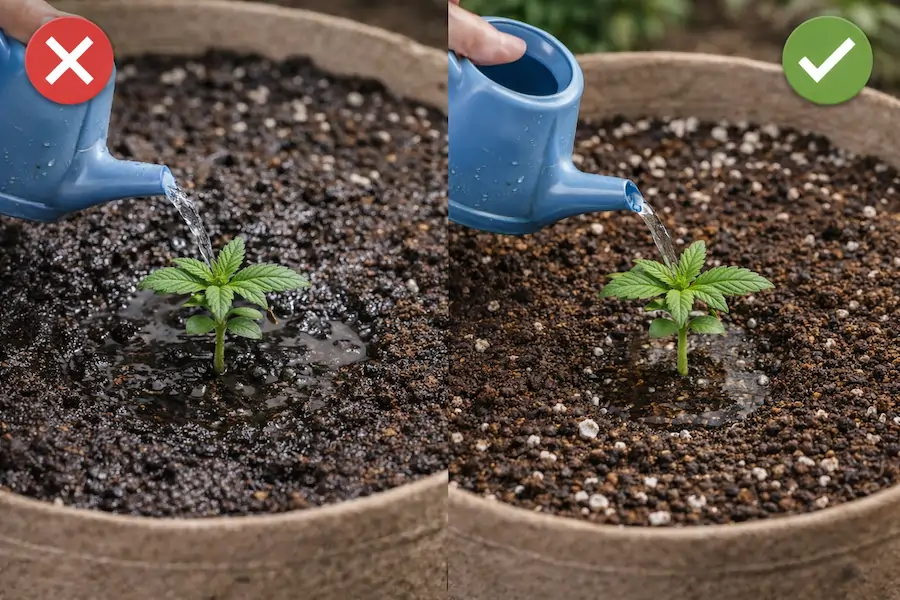
Matty’s watering trick:
Water in a small circle around the seedling — about the size of a coffee cup.
As the plant grows, expand that circle outward.
Keep the rest of the pot lightly moist, not swampy.
If the whole pot stays wet, the plant slows down.
Most beginners don’t realise they’re drowning the plant while trying to “help” it.
The Root-Zone Sauna Problem
This gets even worse in Australian conditions.
A soaked black fabric pot sitting in a hot shed or tent can turn into a root-zone sauna by mid-afternoon.
The top of the soil feels warm.
The middle stays wet.
Oxygen disappears.
And the roots slow down right when the plant is supposed to be accelerating.
That’s why overwatering hits autoflowers so hard in warm climates.
It’s not just “too much water.”
It’s heat + saturation + low oxygen all happening together.
Most growers think the plant is hungry when this happens.
Usually, the roots just stopped breathing properly.
Matty: “A wet autoflower in Aussie heat doesn’t grow slower because it’s thirsty — it grows slower because the roots are suffocating.”
pH and Aussie Tap Water
Most tap water in Australia sits around pH 7.5–8.5.
That’s too high.
If you don’t bring it down to around 6.2–6.5, nutrients get locked out — even if your soil is perfect.
You don’t need to overcomplicate it, but a basic pH test kit goes a long way.
The Early Warning Signs Most Growers Miss
Autoflowers usually warn you before they fully stall.
The problem is the signals are subtle early on.
Watch for:
- watering taking too long to dry back,
- leaves staying overly dark green,
- slightly drooping posture even after lights-on,
- new growth slowing for multiple days in a row,
- the plant widening very slowly instead of “reaching outward” aggressively.
Healthy autos in early veg should feel like they’re expanding daily.
If the plant seems stuck in place for several days during Week 2 or Week 3, something underneath has usually slowed first:
- root oxygen,
- soil temperature,
- water balance,
- or nutrient uptake.
The dangerous part is that growers often react too aggressively here:
- more nutrients,
- more watering,
- more additives.
That usually compounds the slowdown.
Matty’s rule: “When an auto stops expanding early, the answer is usually less interference — not more.”
Using Super Soil (Without Burning Your Plants)
If you want to run richer organic soil, don’t plant directly into it.
Use a layered approach:
- Top layer: light, seedling-safe mix
- Bottom layer: richer soil
That way, roots hit nutrients only when the plant is strong enough to handle them.
Matty’s Advanced Note (If You Want to Push It Further)
Autoflowers don’t just grow fast — they build their root system early, then commit to flower.
If root development is limited in the first few weeks, the plant physically can’t support a larger canopy later.
That’s why soil, aeration, and watering early on matter more than anything you do in flower.
Matty’s Final Word
Autoflowers don’t reward recovery.
They reward uninterrupted momentum.
That’s why the first few weeks matter so much.
Most small autos were never “bad genetics.”
They were plants that lost root momentum early and never got the time to rebuild it.
By harvest, the mistake looks invisible.
You just end up with:
- smaller branches,
- lighter buds,
- less density,
- less overall pressure in the plant.
And most growers never connect that outcome back to the wet, heavy soil from Week 2.
Keep the medium light.
Keep oxygen moving.
Protect the first 21 days like they decide the whole grow — because with autos, they usually do.
Matty’s final rule: “Big autoflowers aren’t built in flower. They’re protected in the root zone before flower ever starts.”