 AUS Stock - Local Delivery

G’day legends — Matty here.
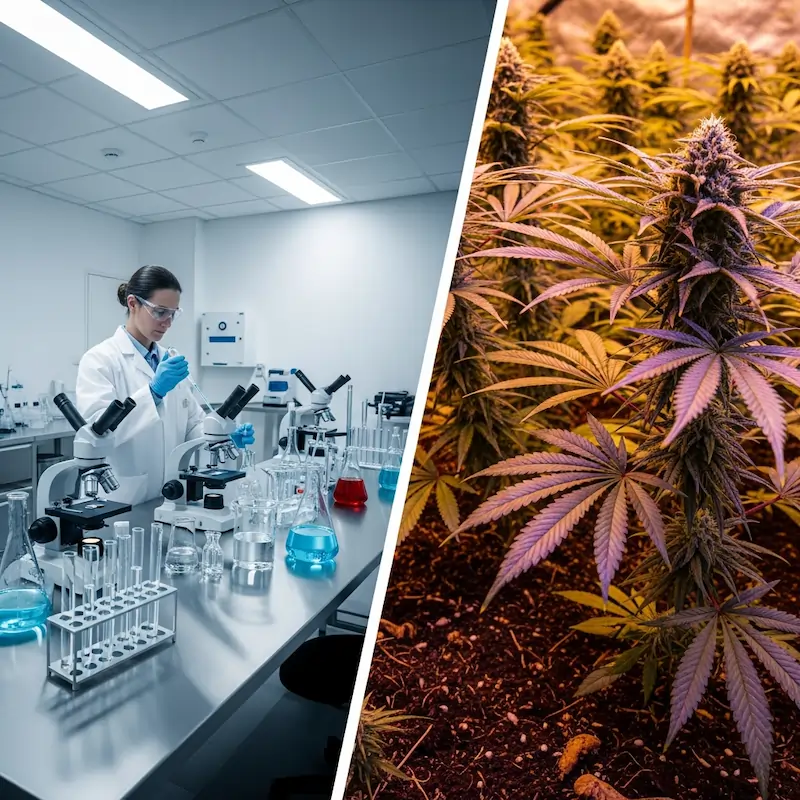
I recently walked into a facility that looked less like a grow room and more like an operating theatre.
Stainless steel everywhere. Triple-HEPA filtration. Staff in full hazmat suits. Automated dosers keeping the pH at a rock-steady 5.8 to the second decimal point. It was “perfect.”
And yet, as I stood there looking at thousands of plants, I felt… nothing.
The plants were a uniform, boring lime green. There was no “funk” in the air. The buds were dense, but they looked like they’d been manufactured in a 3D printer, not grown in soil. When I finally sampled the finished flower, it confirmed my fear: it was hollow. High THC, zero soul.
That room was the victim of the biggest myth in modern cannabis: The Clean Room Lie.
The industry has convinced us that sterile is better. But here’s the truth: Clean is a baseline. Stability is the goal. And total sterility is the enemy of excellence.
The “Hospital” Trap
Somewhere along the line, we started treating cannabis like lettuce or pharmaceuticals. We decided that because “pathogens are bad,” all “biology must be eliminated.”
Growers began using heavy-handed oxidizers like Hydrogen Peroxide (H₂O₂) in their reservoirs every day as a preventative measure. They used synthetic cleaners that stripped the root zone of every living microbe. They created an environment so controlled and so static that the plant essentially became “bored”—meaning its secondary metabolic and stress-response pathways were never chemically triggered.
When you eliminate the background biology of a grow, you remove the plant’s feedback loops. You take away its ability to adapt, to struggle, and most importantly—to express its full genetic potential.
Cannabis Is a Defensive Athlete
You have to understand what a terpene actually is. And you definitely need to understand what an Anthocyanin (that purple pigment you’re chasing) is.
These aren’t “flavour additives” the plant makes for our enjoyment. They are defensive compounds. A plant produces deep purples and complex, pungent oils as a response to its environment. It’s a shield.
These compounds are regulated through stress-signalling pathways tied to nutrient availability, redox balance, and carbohydrate allocation. In a perfectly sterile, static, and “safe” room, the plant has no biological reason to “turn on” these expensive metabolic pathways.
Sterile rooms produce sterile weed because the plant has nothing to talk to.
The Stability Doctrine: Rhythms > Rules
Cleanliness prevents chaos. But Stability is what allows for expression.
If your room is sterile, you are forced to be “perfect” every second. If you miss one feeding or the temp spikes for an hour, the plant has no biological buffer to save it. It crashes. In a Stable System, we don’t aim for a static line; we aim for a healthy rhythm. This is most evident in your pH management.
The “clean room” crowd swears by a locked 5.8 pH. They think they’re being precise; I reckon they’re being lazy.
The Molecular Battery: The pH Oscillation
If you want those deep, royal purples—the kind that look like they’re bruised into the calyx—you have to understand the Electrochemical Gradient.

A plant isn’t just a sponge; it’s a battery. To pull nutrients across a cell membrane, the plant has to manage a “proton pump.” When you lock your pH at exactly 5.8, you are essentially asking the battery to provide a constant, unvarying voltage. In nature, that never happens.
By allowing your pH to oscillate naturally between 5.7 and 6.3 over a 24-to-48-hour cycle, you are doing more than “mixing up the menu.” You are modulating the Redox Potential of the rhizosphere.
As the pH moves:
- The Proton Pump Engages: The plant actively adjusts its internal chemistry to keep up with the changing external acidity. This metabolic “work” triggers the production of Phenylpropanoids—the chemical precursors to both smell and colour.
- The Mineral Buffet: Iron and Manganese—the architects of enzyme function—become available at different “rungs” of that pH ladder.
- The Anthocyanin Trigger: This metabolic “friction” signals to the plant that the environment is dynamic. The plant responds by “armouring up” with anthocyanins (purples) to protect its tissues from perceived fluctuations.
The purple coloration is the plant’s way of saying, “I’m fully engaged with my environment.” You don’t get that in a sterile hospital room. You get it in a stable, living system.
The Rhythm Is the Metric
If you’re ready to stop the “Hospital Habit,” follow this operational framework:
- The Swing Window: Allow pH to drift from 5.7 up to 6.3 before correction.
- The Cycle: This drift should ideally occur over a 24–48 hour period.
- Manual Over Auto: Disable continuous automated pH-down dosing. Let the biology breathe.
- The Guardrail: There is a time for peroxide (H₂O₂)—outbreaks, root rot, and emergencies. This isn’t about banning tools; it’s about banning habits that kill your quality.
The Case of the Clinical Crop (Real World Evidence)
I’ll give you a real-world example. A mate in Melbourne had a high-spec LED run that was stalling out. Total sterile res, $H_2O_2$ flushes every three days, perfectly “clean” runoff.
The plants were healthy but “flat”—no colour, no smell.
The Matty Fix: We stopped the H₂O₂ immediately to allow the rhizosphere to recover. We introduced a high-quality microbial inoculant to provide a biological buffer. Then, we turned off the automated pH-down doser and let the reservoir naturally swing.
The Result: Within 72 hours, the stems started showing burgundy streaks. By day 10, the fan leaf stems were deep purple, and the buds began “bleeding” that royal violet from the inside out. The smell changed from “wet grass” to “gas and berries.”
We didn’t change the genetics. We just stopped lying to the plant that it lived in a hospital.
The Verdict
The best rooms I’ve ever been in aren’t the ones that smell like bleach. They’re the ones that smell like life.
Be clean enough to prevent a breakout. But be stable enough to let the plant breathe. Stop chasing sterility. Start managing the rhythm. That hospital room didn’t fail because it was dirty—it failed because it was afraid to let the plant respond.
That’s where the soul of the plant lives.
— Matty