 AUS Stock - Local Delivery

G’day legends — Matty here.
Let me tell you about a run I visited last month. On Monday, the plants were 9/10. On Wednesday, they were in the bin.
What happened? A pest outbreak? A power failure? A flood?
Nah. It was worse. The grower had a “productive” Tuesday.
He saw a tiny bit of tip burn (probably just the plant finishing a heavy feed) and he panicked. By lunch, he’d flushed the pots. By 3 PM, he’d added a massive dose of Cal-Mag “just in case.” By dinner, he’d dimmed the lights because he thought they were “stressed,” and by midnight, he’d adjusted the pH of his reservoir twice.
He didn’t fix a problem. He created a catastrophe.
This is The Overcorrection Trap, and it is the silent killer of elite cannabis.
I’ve wrecked more good runs this way than I care to admit. That’s how I know.
The Mismatch: Fast Growers vs. Slow Plants
The fundamental mistake in modern cultivation is a misunderstanding of time.
As humans, we live in seconds. If we’re hungry, we eat. If we’re cold, we put on a jumper. We expect immediate feedback.
Plants do not work on human time. Most physiological responses in cannabis operate on a 48–96 hour delay — roots respond first, but the leaves are the last to report.
A leaf showing a yellow spot today isn’t telling you what happened five minutes ago. It’s showing you the results of a mistake made three days ago. When you react instantly to that spot, you are trying to fix the past with a hammer that hits the future.
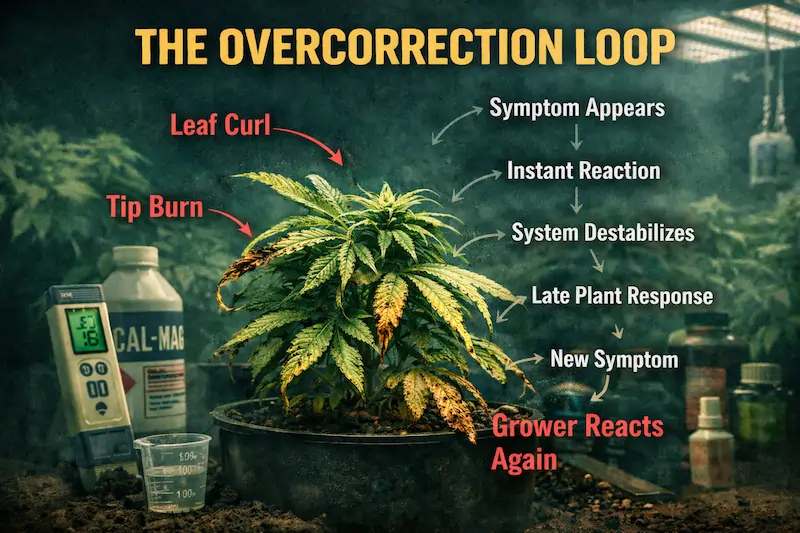
The Overcorrection Loop
When we ignore the biological lag, we fall into a destructive cycle that destabilises the entire system:
- A symptom appears: A leaf twists, a fade starts, or a claw develops.
- The grower reacts instantly: “I need to fix this NOW.”
- The system destabilises: You throw the chemistry and environment into a spin.
- The plant responds late: The plant was already trying to fix the first issue; now it has to deal with your “fix” too.
- New symptoms appear: The stress of the “fix” creates a new secondary deficiency.
- The grower reacts again: The cycle repeats until the crop is trashed.
The plant wasn’t failing. The grower was.
The “Just In Case” Poison
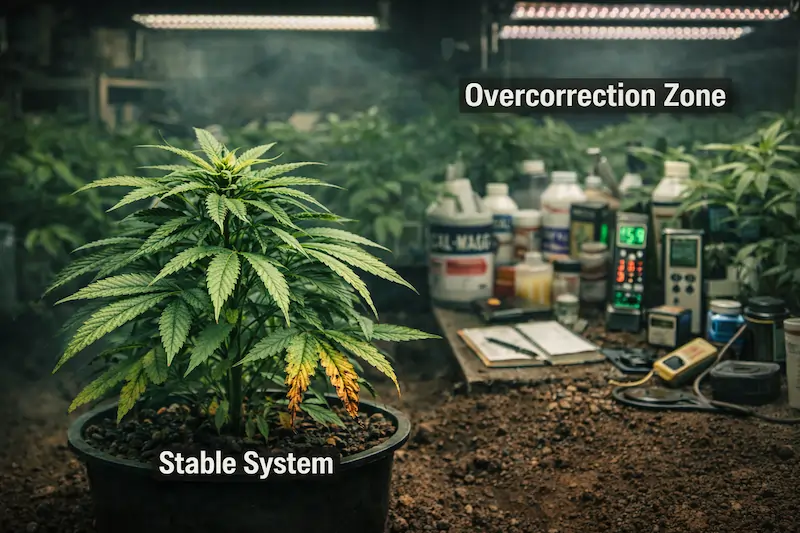
We’ve all been there. You see a slight fade in the green and you reach for the bottle.
- “Maybe it needs more nitrogen?”
- “Better add some peroxide to the res… just in case.”
- “I’ll just bump the pH down to 5.5 to unlock the P.”
Every one of those “small” adjustments is a seismic shift for the plant’s internal proton pumps and osmotic pressure. You aren’t “helping” the plant; you’re interrupting its conversation with the environment.
And plants hate being interrupted mid-sentence.
You’ve learned nothing, lost your baseline, and stressed the girl to the point of herming — turning a potential win into a seeded, low-value disaster.
Elite cultivation isn’t about doing more. It’s about having the stones to do nothing.
The Matty Rule: One Variable, One Cycle
If you want to move from a hobbyist to a master, you need to adopt a Doctrine of Restraint.
Here is my Golden Rule: Change one thing. Then wait a full cycle.
If you adjust your feed strength on Monday, you don’t touch the pH, the lights, or the CO₂ until Thursday at the earliest. You have to give the plant’s biology time to “answer” your move.
If you stack corrections, you lose the signal. When the plant finally looks better (or worse), you have no idea which of your five “good ideas” actually caused the result.
Why Doing Nothing Is Sometimes the Correct Move
I’ve seen more runs “fix themselves” by the grower going on holiday for a weekend than by any bottled additive.
Why? Because the plant is a biological engine. It has its own internal balancing act. Often, a “symptom” is just a temporary adjustment — the plant moving mobile nutrients around or responding to a slight temperature spike.
If you see something “wrong,” give it a 72-hour grace period:
- Is it spreading?
- Is it getting worse?
- Or is the new growth coming out clean?
Stop treating the leaf. Start reading the system.
The Verdict
The best growers I know don’t have better instincts or “greener thumbs” than you. They just have better restraint.
They’ve realised that the plant knows how to be a plant better than we do. Our job isn’t to micromanage every cell; our job is to provide a stable stage and then get out of the way.
This lesson cost me years. I’m giving it to you for free.
Next time you feel the urge to “fix” your room at 10 PM on a Tuesday… go have a beer instead.
Your plants will thank you for it in the morning.
— Matty
Well written Matty. Keep it coming.