 AUS Stock - Local Delivery

Every cannabis grower has had that moment.
You open the grow tent, look at your plants… and suddenly a few leaves are turning yellow.
Your brain immediately jumps to worst-case scenarios.
Is it nutrients? Overwatering? Pests? Did I ruin the grow?
Relax. Yellow leaves don’t always mean disaster. Sometimes they’re a warning sign. Sometimes they’re completely normal.
I’ve seen growers tear half the room apart over a couple yellow leaves. Nine times out of ten, the plant was just trying to say something simple.
The key is learning how to read where the yellowing appears and how fast it spreads.
Once you understand those signals, diagnosing cannabis plants becomes much easier.
— Matty
Matty’s 30-Second Yellow Leaf Diagnosis
| Symptom | Most Likely Cause |
|---|---|
| Lower leaves turning yellow | Nitrogen deficiency |
| Yellow between leaf veins | Magnesium deficiency |
| Leaf edges yellow then brown | Potassium deficiency |
| Top leaves yellow first | Iron or sulfur deficiency |
| Yellow speckles across leaves | Spider mites |
| Yellowing late in flower | Natural fade (senescence) |
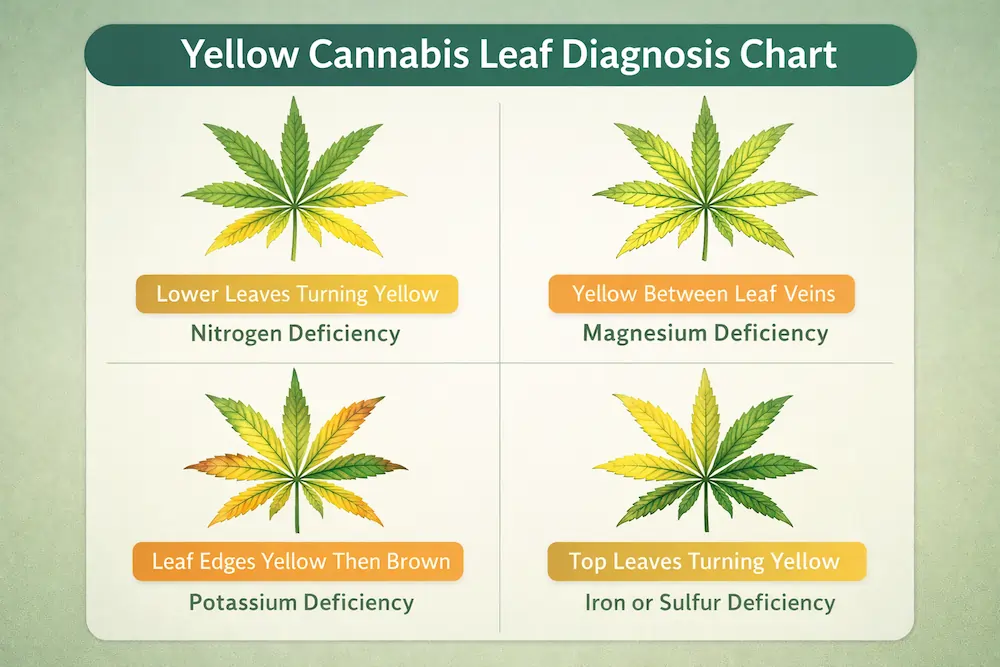
The Pro Grower Rule: Mobile vs. Immobile Nutrients
Professional cultivators diagnose plant problems by looking at where the symptoms appear first.
- Mobile nutrients (Nitrogen, Magnesium, Potassium) can move through the plant.
- If the plant becomes deficient, it steals nutrients from older leaves first.
This is why nitrogen deficiencies typically appear at the bottom of the plant first.
- Immobile nutrients (Calcium, Iron, Sulfur) cannot move once placed in a leaf.
- Deficiencies therefore appear on new growth at the top of the plant.
Matty’s tip: Bottom first usually means a mobile nutrient issue. Top first usually means an immobile nutrient problem.
Yellow vs. Pale Green (A Critical Difference)
Not every colour change means the same thing.
- Pale lime-green plants often mean the plant is slightly hungry or experiencing mild pH drift.
- Bright yellow leaves usually indicate a true nutrient deficiency.
Pale plants are usually just a bit hungry.
Bright yellow leaves mean the plant is already struggling.
1. Nitrogen Deficiency (The Classic Yellow Leaf)
Nitrogen is responsible for healthy green growth.
Because nitrogen is a mobile nutrient, the plant moves it from older leaves to newer growth when supplies run low.
- Lower leaves turn yellow first
- Leaves may eventually fall off
- Upper growth remains green
Think of nitrogen like emergency food rations. When supplies run low, the plant raids the pantry down below so it can keep feeding the new growth up top.
Matty’s grow-room rule: if the bottom leaves are fading but the tops still look strong, nitrogen is usually the issue.
2. Magnesium Deficiency
Magnesium plays a key role in photosynthesis.
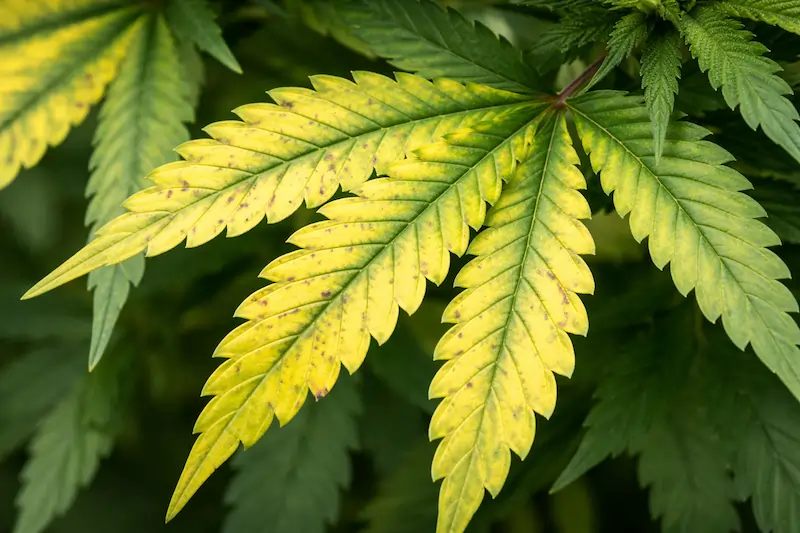
Instead of whole leaves turning yellow, magnesium problems create interveinal chlorosis — yellowing between the veins.
- Leaf veins stay green
- Leaf tissue turns yellow
- Older leaves affected first
Rust spots may appear if the deficiency continues.
This problem is often corrected with Epsom salts or a Cal-Mag supplement.
3. Potassium Deficiency
Potassium deficiencies usually begin along the edges of leaves.
- Leaf edges yellow first
- Edges eventually become brown and crispy
- Older leaves affected before new growth
This issue often appears when nutrients become unbalanced or when pH prevents potassium uptake.
4. Iron Deficiency (Common Under Powerful LED Lights)
Iron deficiency affects new growth first.
The leaves show interveinal yellowing while veins remain green.
- Top leaves yellow first
- Green veins remain visible
- New growth appears pale
This is often caused by high pH or intense LED lighting increasing plant metabolism faster than nutrient uptake.
5. Sulfur Deficiency (Rare but Confusing)
Sulfur deficiency resembles nitrogen deficiency but starts at the top of the plant.
- Yellowing appears on new growth
- Older leaves remain relatively green
This occasionally appears in coco grows or when using heavily filtered water.
6. Overwatering
Overwatering is usually a problem of frequency, not volume.
The Leaf Turgor Test
- Yellow leaves + firm droop → overwatering
- Yellow leaves + limp wilt → underwatering
Experienced growers look at the posture and firmness of leaves, not just their colour.
Matty’s rule: if the pot still feels heavy, don’t water yet.
If you’re stuck in that “maybe I should just give it a little drink” headspace, wait another day. Cannabis usually hates wet feet more than it hates being slightly thirsty.
7. pH Lockout
Sometimes nutrients are present in the soil but the plant cannot absorb them.
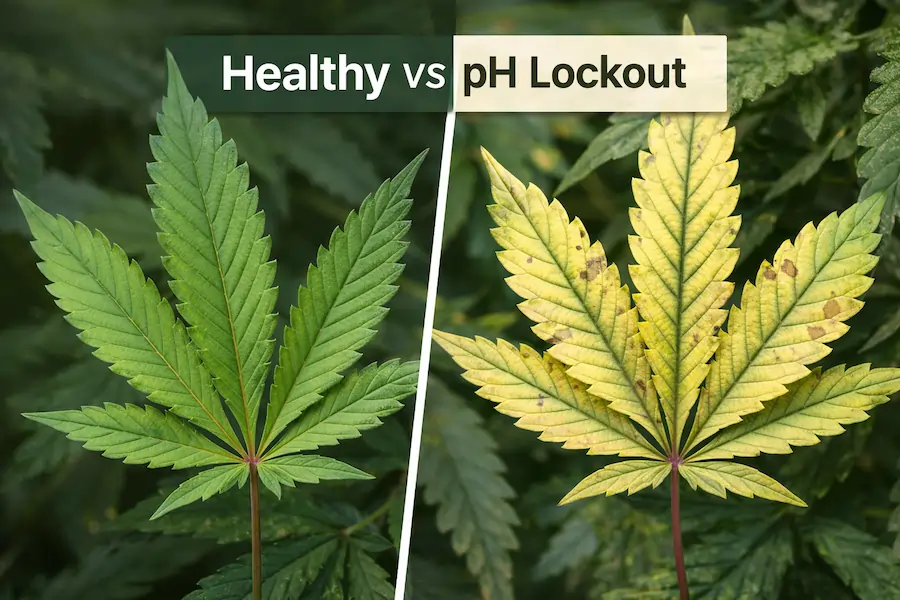
This is known as pH lockout.
- Soil: pH 6.0 – 7.0
- Hydro / coco: pH 5.5 – 6.5
The Flush and Buffer Reset
If soil pH drops below about 5.8, nutrients may become unavailable.
In that case growers perform a flush and buffer reset.
- Flush with about three times the container volume of water
- Adjust water to around pH 6.5
- Allow runoff to remove salt buildup
Matty’s rescue trick: lightly foliar feed the plant while correcting the root zone so the leaves can absorb nutrients directly.
8. Spider Mites
Spider mites feed on plant cells and leave behind tiny pale speckles.
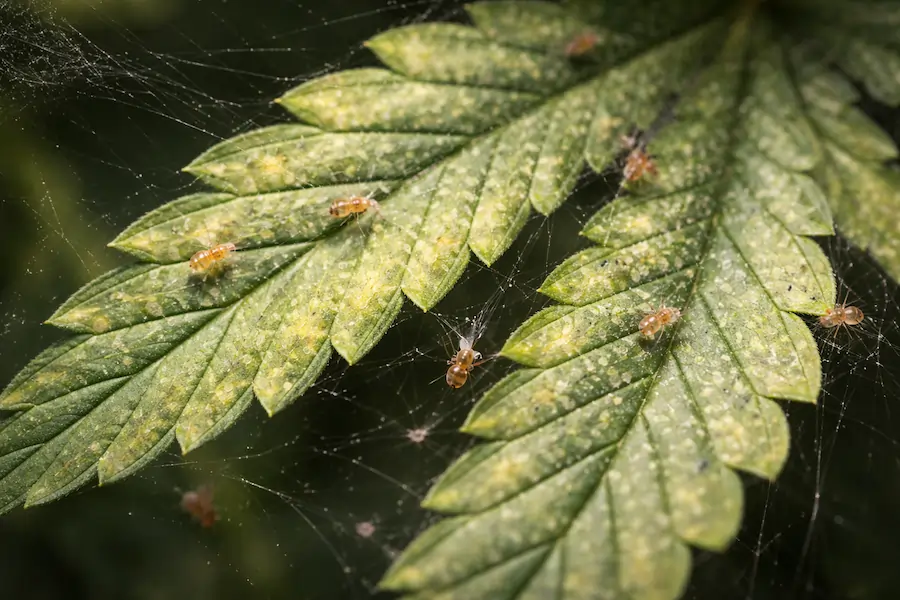
Over time the leaves may appear yellow or bronze.
Look under the leaves for fine webbing and tiny moving insects.
9. Natural Yellowing During Flowering
In late flowering cannabis plants begin using stored nutrients from older leaves.
This process is known as senescence.
Healthy plants may fade into soft yellows, reds, or purples during the final weeks.
The Yellow-to-Purple Connection
If yellowing leaves are combined with deep purple stems or leaf undersides early in growth, the problem may be phosphorus lockout.
This often occurs when root temperatures fall below about 15°C (60°F).
Cold roots can prevent phosphorus uptake even when nutrients are present.
Matty’s tip: if yellowing and purple stems appear together, check root temperature before adding more nutrients.
Environment Can Cause Yellow Leaves Too
Sometimes the problem isn’t nutrients — it’s the air.
If temperatures drop below about 18°C (65°F), cannabis metabolism slows down.
This can cause magnesium lockout even when nutrients and pH are correct.
Cold grow rooms are one of the most overlooked causes of yellow leaves.
Matty’s 5-Minute Yellow Leaf Checklist
- Check where yellowing begins (top or bottom)
- Check soil moisture
- Measure pH levels
- Inspect for pests
- Review nutrient schedule
Most problems reveal themselves within a few minutes of inspection.
A Real Lesson from Matty’s Grow Room
A grower once sent me photos of bright yellow tops under a powerful LED setup.
He kept adding nitrogen because he thought the plants were starving.
The strange part was the bottom leaves were perfectly green.
Using the mobile vs. immobile rule, we realized it wasn’t nitrogen at all.
The issue was iron lockout caused by alkaline irrigation water.
His water was coming in at pH 7.5.
After adjusting the irrigation to pH 6.2, the next set of leaves emerged deep green within two days.
Matty’s lesson: logic beats guesswork every single time. Once you understand how the plant moves nutrients, half the panic disappears.
Final Thoughts
Yellow cannabis leaves are one of the most common grow problems.
But they’re also one of the easiest to diagnose once you understand the patterns.
Look at the location, speed, and texture of the symptoms before making changes.
Your plants are constantly communicating what they need.
Once you learn to read those signals, growing becomes far less stressful.
After a few runs, you’ll start spotting these patterns in seconds. That’s when you realise cannabis plants are actually pretty honest — they tell you exactly what’s wrong if you know how to look.
— Matty