
 AUS Stock - Local Delivery

You bend the branch. It folds over beautifully. Forty-eight hours later, the top is standing back up like nothing happened.
You grin, shut the tent, and think: “Nailed it.”
Sometimes you did.
Sometimes the plant already slowed down internally and you just didn’t notice yet.
That’s the bit most super cropping cannabis guides never talk about.
I’ve seen experienced growers quietly lose 20% of their canopy potential because the branch looked healed while the plant was still recovering biologically underneath.
That’s what this article is really about.
Not just how to bend a branch.
How to tell whether the plant actually came back stronger afterwards.
Because advanced super cropping isn’t really branch training.
It’s controlled vascular interruption during active hormonal redistribution.
Done correctly, the plant responds aggressively — thicker knuckles, faster lateral growth, stronger canopy distribution, heavier flower stacking.
Done badly, the branch still heals… but the plant quietly shifts into survival mode instead of production mode.
The dangerous part?
Most growers never notice the difference until harvest.
Matty: “The bend matters less than what the plant does two days later.”
You’re Not Bending a Branch — You’re Triggering a Survival Response
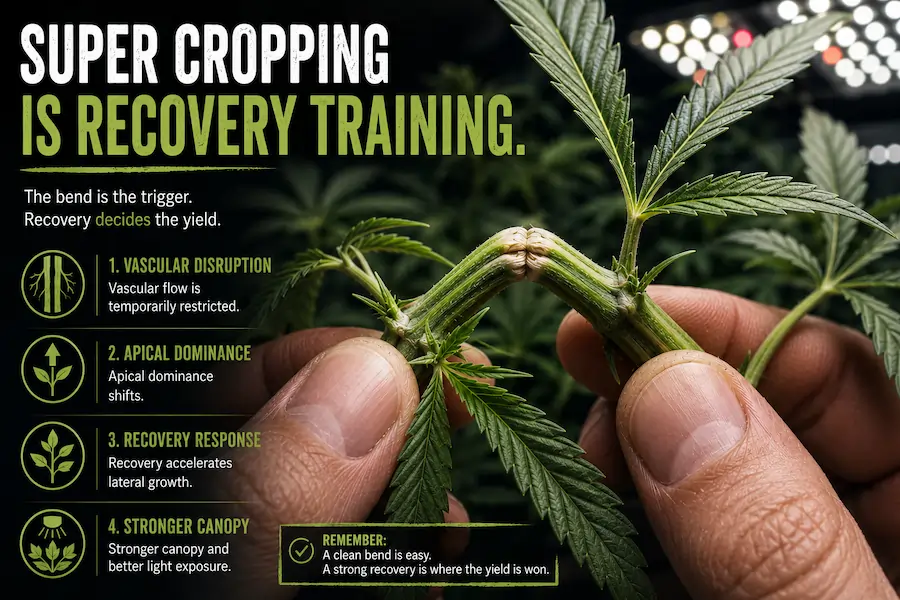
When you super crop cannabis properly, you’re not “breaking” the plant.
You’re interrupting vascular flow just enough to force a hormonal and structural response.
Inside the stem are vascular tissues — xylem and phloem — responsible for moving water, sugars, minerals, and growth hormones through the plant.
Super cropping temporarily disrupts that flow.
The plant interprets that disruption as damage.
And cannabis reacts to perceived damage aggressively.
Auxin distribution changes.
Lateral growth accelerates.
Defensive structural tissue thickens.
The branch develops a hardened “knuckle” to reinforce the weakened point.
That’s the visible part growers recognise.
But the invisible part matters more.
The plant reallocates energy priorities during recovery.
If recovery is strong, momentum increases.
If recovery is weak, the canopy quietly loses aggression.
That’s why two identical bends can produce completely different harvests.
Matty: “The plant thinks something important just failed — your job is making sure she responds aggressively instead of defensively.”
The Myth That Quietly Flattens Yields
The biggest misunderstanding in advanced super cropping is this:
“If the branch stood back up, the super crop worked.”
Nope.
Structural recovery and biological recovery are not the same thing.
A branch can physically heal while the plant still slows down hormonally underneath.
That’s where growers quietly lose production.
Here’s what failed recovery actually looks like:
- Lower sites stop accelerating after the bend
- Canopy drinking slows slightly during stretch
- Leaf posture stays flatter instead of praying upward
- Internodal aggression softens for several days
- New growth thickens instead of extending
- Flower stacking later feels “heavier but lazier”
The branch healed.
The canopy momentum didn’t.
That’s the trap.
Matty: “A plant standing back up doesn’t always mean she trusted the stress.”
The Dangerous Timing Shift Most Growers Miss
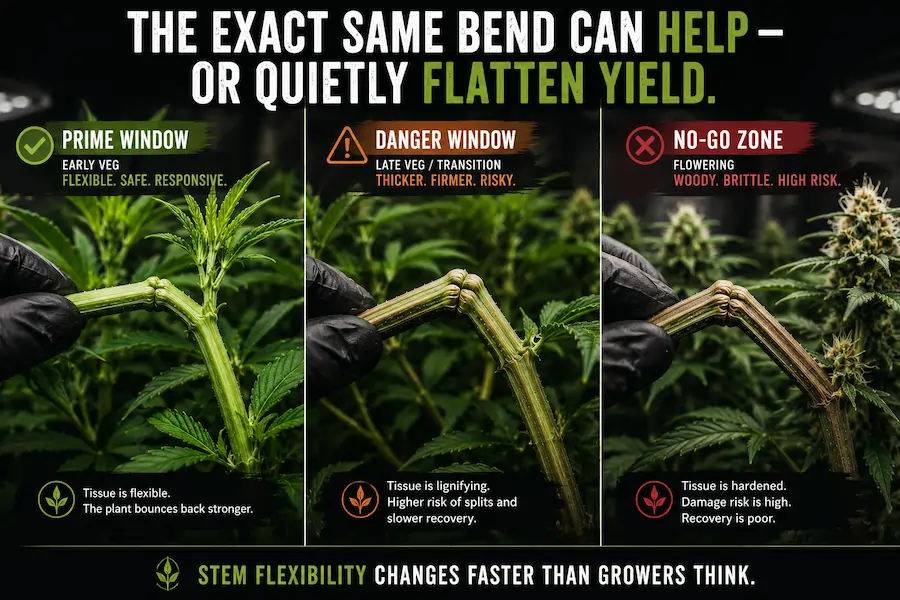
The exact same super crop can be perfect on Day 18… and damaging on Day 27.
Same pressure.
Same branch.
Different biology.
The reason is stem lignification.
Lignification is the process where soft, flexible stem tissue hardens into structural support material.
Young stems negotiate stress.
Older stems resist it.
That shift happens faster than most growers realise.
And it usually begins internally before the outside of the stem fully hardens.
That’s why a branch can still feel flexible while already entering the danger phase biologically.
When is the best time to super crop cannabis?
Prime Window: aggressive vegetative growth before structural hardening begins.
Danger Window: late veg into transition stretch, where recovery capacity starts narrowing quickly.
No-Go Window: mid flower onward, when vascular recovery competes directly against bud production.
The irreversible mistake usually happens right at the start of the Danger Window.
The branch still bends cleanly.
But recovery no longer fully restores production momentum afterwards.
That loss is permanent.
Matty: “Warm healthy stems negotiate. Cold tired stems snap.”
How to Read a Stem Before You Bend It
Good super cropping starts before you touch the branch.
The stem tells you whether the plant is ready.
Healthy super crop candidates feel:
- Hydrated but elastic
- Firm without feeling brittle
- Supple under rolling pressure
- Evenly dense without hollow spots
- Actively growing at the tip
Bad candidates feel:
- Dry or fibrous
- Cold and stiff
- Overly woody near the centre
- Thin-skinned but internally rigid
- Already stressed from pruning, heat, drought, or feeding swings
The dangerous stems are the ones that still bend externally while already hardening internally.
That’s when you get “successful” bends with weak recovery afterwards.
One trick I use late in veg:
Warm the branch slightly with your fingers before applying pressure.
Healthy hydrated tissue becomes noticeably more elastic under warmth.
Tired lignifying tissue barely changes.
That tells you a lot before you commit.
Matty: “Healthy stems cooperate. Hardened stems tolerate.”
How to Super Crop Cannabis Properly — The Quick Version
If you came here for the actual hands-on method, here’s the clean version.
- Choose a healthy, flexible branch during vegetative growth.
- Pinch the stem gently between your thumb and forefinger where you want the bend.
- Roll the stem slowly until the inner tissue softens without splitting the outer skin.
- Bend the branch into position gradually — don’t force a sharp snap.
- Support any risky bend with plant tape if the outer layer tears or weakens.
- Watch recovery for the next 24–48 hours. Standing back up is good, but aggressive recovery is what matters.
That’s the technique.
But the technique is only half the job.
Matty: “The bend takes seconds. The recovery decides the harvest.”
The Recovery Window — Where Yield Is Actually Decided
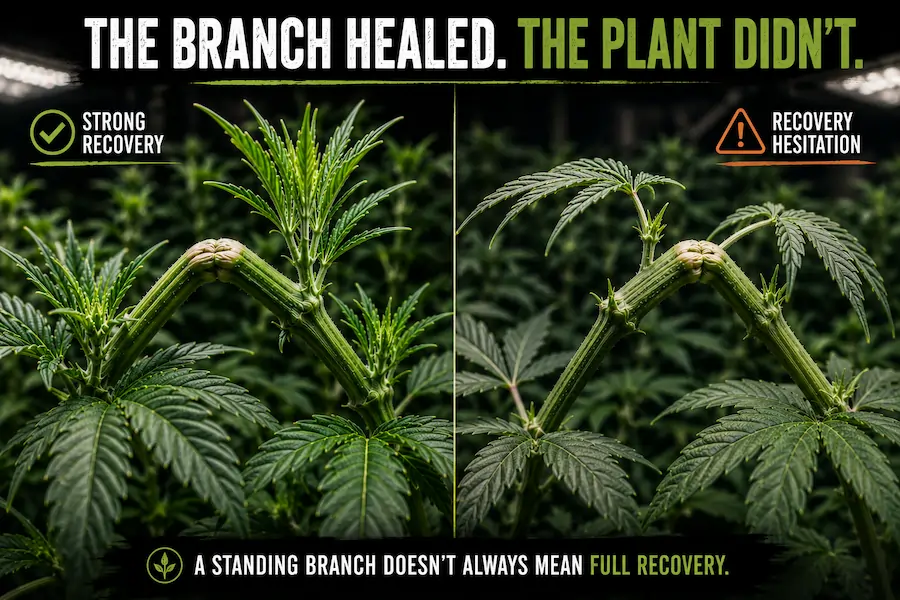
The bend itself isn’t the important part.
The next 48 hours are.
This is where the plant decides whether the stress was productive… or threatening.
Healthy recovery looks like this:
- Leaves begin praying upward again within 12–24 hours
- Water uptake normalises quickly
- Secondary sites accelerate visibly
- Leaf posture regains confidence fast
- Canopy energy increases instead of flattening
Panic recovery looks different:
- Droop lingers beyond 48 hours
- Leaf posture stays flat or hesitant
- Growth thickens but stops extending
- Canopy drinks less during stretch
- Lower sites stop accelerating
That’s the dangerous recovery.
Not the dramatic break.
The quiet slowdown.
And once the plant shifts into conservation mode during recovery, flower-site commitment during stretch is permanently reduced.
You do not recapture that lost production later.
And because the decline happens gradually, most growers blame genetics instead of recovery — which means they repeat the mistake on the next run.
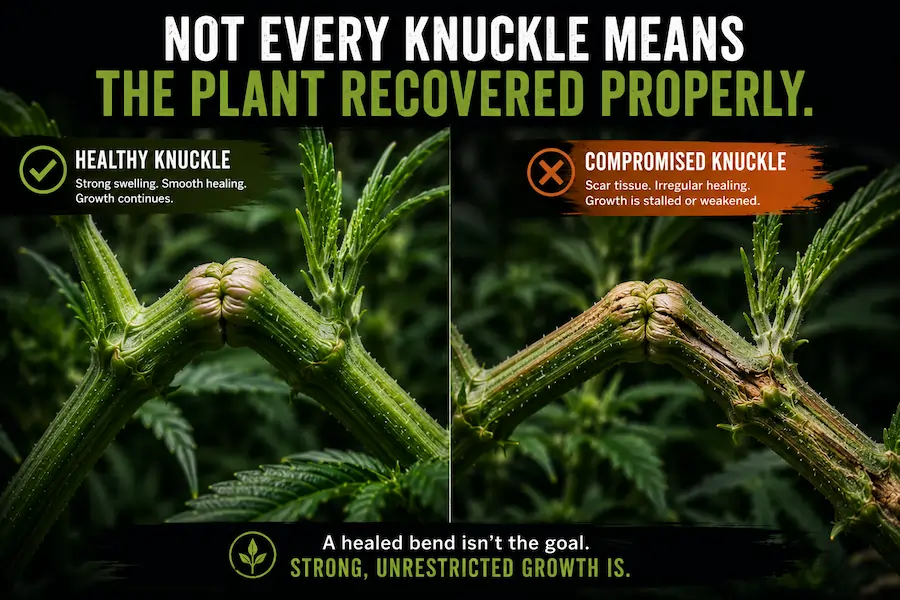
Matty: “The dangerous super crops aren’t the dramatic ones — they’re the ones that quietly slow the whole room down.”
Super Cropping vs Topping vs LST — The Trade-Off Most Growers Miss
Topping removes dominance permanently.
LST redirects dominance gently.
Super cropping interrupts dominance temporarily through controlled stress.
That difference matters.
Topping creates predictable structural division.
LST preserves momentum but reshapes light exposure gradually.
Super cropping creates the fastest hormonal redistribution — but also carries the highest recovery risk.
That’s why experienced growers often combine all three.
Topping for structure.
LST for positioning.
Super cropping for aggressive canopy control during active growth.
The mistake is using super cropping when simple positioning would have achieved the same goal with less recovery cost.
Matty: “That’s why super cropping is the only training technique that can go wrong without looking wrong.”
Which Cannabis Strains Reward Super Cropping Best?
Not every strain responds to aggressive training the same way.
Fast-growing hybrid and sativa-dominant plants usually reward super cropping most aggressively because they recover fast and redistribute hormones efficiently.
Strains like Bruce Banner Feminised, Super Lemon Haze, and Blue Dream Feminised usually respond beautifully when timed correctly.
Dense resin-heavy strains are different.
Plants like Gorilla Glue #4 and Godfather OG can recover well structurally… but late recovery hesitation often compounds into airflow and flower-density problems later in bloom.
And autos?
That’s where growers get reckless.
Autos have a fixed lifecycle.
If recovery slows during the wrong developmental window, the plant usually doesn’t have time to fully compensate before flower commitment begins.
That’s why aggressive super cropping on autos like GG4 Auto or Blue Dream Auto carries far more risk than photoperiod plants.
Matty: “Photoperiods negotiate with stress. Autos negotiate with the calendar.”
The Environmental Multiplier Most Growers Ignore
Recovery quality isn’t just genetic.
The room decides whether the plant interprets stress as opportunity or danger.
Cold roots, unstable VPD, humidity swings, poor airflow, or feeding inconsistencies all amplify recovery hesitation after a super crop.
That’s why some growers swear super cropping explodes yields… while others swear it stunts plants.
They’re often performing the same bend inside completely different environments.
If you haven’t already dialled airflow, humidity, and transpiration properly, read our Humidity & VPD Guide before getting aggressive with stress training.
Because recovery quality is environmental long before it becomes genetic.
Matty: “The plant doesn’t judge stress by the bend. She judges it by whether recovery feels safe afterwards.”
Matty’s Final Principle — You’re Training Recovery, Not Branches
That’s the shift most growers never fully make.
They think advanced super cropping is about branch position.
It isn’t.
It’s about biological confidence after controlled stress.
The bend itself takes seconds.
The recovery decides the harvest.
That’s why experienced growers stop asking:
“Did the branch survive?”
And start asking:
“Did the plant come back stronger… or just recover enough to continue?”
Because cannabis plants remember stress a lot longer than growers think.
And the biggest yield losses are usually the invisible ones.
Matty: “You’re not training branches. You’re training recovery.”
Ready to apply it properly? Browse our feminised cannabis seed range — including the strains that respond best to aggressive training and canopy shaping.
Part 2 — Super Cropping 2.0
Ready for the next layer?
Part 2 of the HST Series covers heat-assisted stem manipulation, recovery sequencing, and advanced canopy steering techniques that multiply the gains from what you just learned here.
Because once you understand recovery properly, super cropping stops being branch management.
It becomes structural control.