
 AUS Stock - Local Delivery

HST Series Part 2 — Matty’s Advanced Mainlining Guide
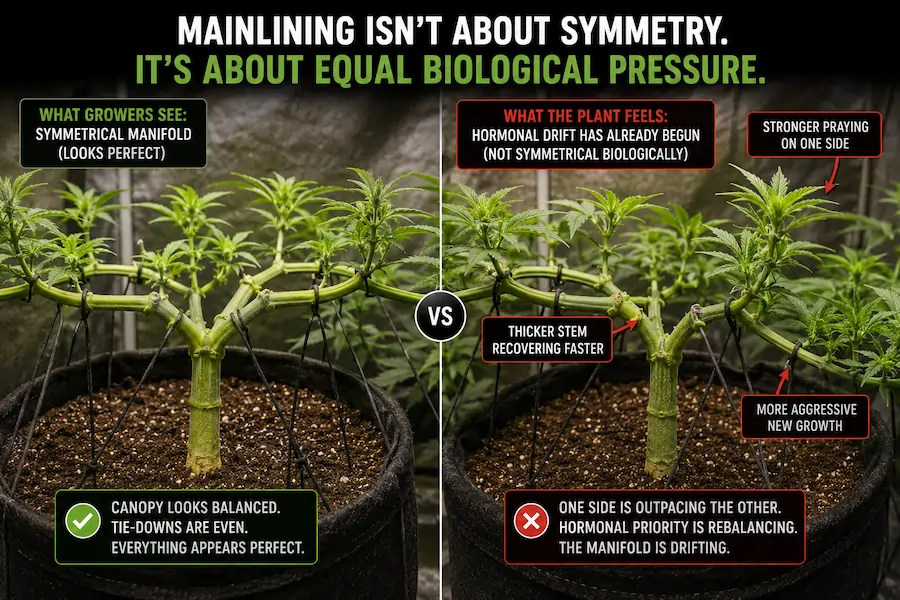
You top the plant. Tie the arms down perfectly. Everything looks symmetrical. Clean. Balanced. Professional.
So you assume the manifold worked.
Sometimes it did.
Sometimes one side already recovered harder than the other — and you didn’t notice until flower stacking started drifting weeks later.
That’s the bit most mainlining cannabis guides never explain.
Because mainlining isn’t really about symmetry.
It’s about equal biological pressure.
And once one side of the plant starts recovering faster, drinking harder, or pushing upward more aggressively than the other, the manifold quietly stops behaving like a true manifold — even if it still looks perfect from above.
I’ve seen growers lose cola consistency, canopy timing, and final weight while still staring proudly at a plant that looked beautifully mainlined from the top of the tent.
Mainlining works by interrupting auxin hierarchy — the plant stops heavily prioritising one top because every arm shares nearly identical vascular distance from the central hub.
That’s the real mechanism.
And once you understand that, mainlining stops being plant sculpture.
It becomes recovery engineering.
The Myth That Quietly Ruins Most Mainlines
“If the manifold looks symmetrical, it’s healthy.”
This is the trap.
Growers obsess over equal tie-downs, matching branch angles, and clean-looking manifolds.
Meanwhile the plant itself is redistributing dominance underneath.
Because symmetry is not visual.
Symmetry is hormonal.
You can have equal-looking arms while one side drinks harder, thickens faster, receives slightly stronger light, and slowly becomes dominant again internally.
The dangerous part?
It usually happens quietly during recovery windows — not during the topping itself.
Matty: “A manifold can look balanced long after the plant stopped behaving balanced.”
What’s Actually Happening Inside a Mainlined Plant
Mainlining works because equal vascular distance creates more equal hormonal priority.
Normally, cannabis behaves like a hierarchy.
The highest top receives the strongest auxin pressure, dominates growth, and suppresses lower sites underneath.
Mainlining repeatedly interrupts that hierarchy.
Every topping event forces the plant to redistribute growth pressure outward instead of upward.
That’s why equal arm length matters so much.
Equal distance from the hub creates more even nutrient resistance, more balanced hormone signalling, and more consistent recovery behaviour.
But once one side starts thickening earlier, recovering faster, or receiving stronger environmental input, the hierarchy quietly begins rebuilding itself again.
And the manifold slowly stops acting like one coordinated structure.
Matty: “Mainlining only works while the plant still believes every arm matters equally.”
The Irreversible Moment Most Growers Never Notice
There’s a point where the manifold stops behaving evenly — and correction becomes extremely expensive biologically.
The warning signs are subtle:
- One side drinks noticeably faster.
- One arm thickens earlier.
- One branch prays harder toward the light.
- One side develops tighter node spacing.
- One knuckle swells more aggressively.
- One side begins vertical push sooner after recovery.
That’s not random plant behaviour.
That’s hormonal priority quietly returning.
If one side continues consistently outpacing the other for more than roughly 5–7 days without correction, the dominant vascular pathway is usually already reinforcing itself internally.
At that point, correcting symmetry costs far more recovery energy than preventing the drift early.
The dangerous part is that growers usually miss it because the canopy still looks symmetrical from above.
Matty: “The dangerous manifolds aren’t the ugly ones — they’re the ones drifting quietly while still looking clean.”
When Should You Start Mainlining Cannabis?
The sweet spot is usually 5–6 healthy nodes during aggressive vegetative growth.
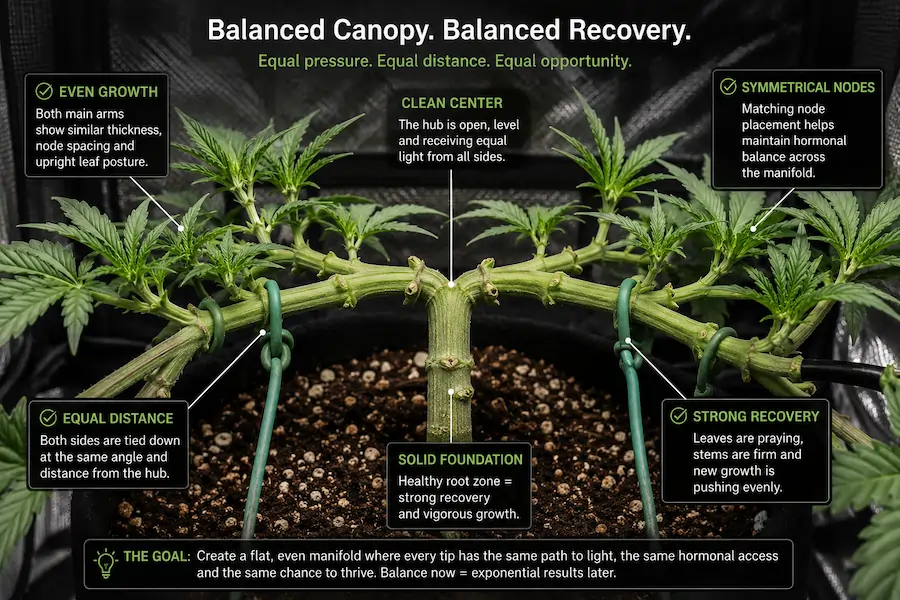
You want:
- Strong leaf posture
- Fast drinking behaviour
- Flexible stem tissue
- Healthy lateral growth
- Active recovery momentum
For most photoperiod strains, that’s around Week 3–4 from seed.
But don’t grow by calendar alone.
Grow by recovery behaviour.
Healthy stems recover aggressively after stress.
Tired stems hesitate.
Matty: “You’ll know the manifold is really working when both arms argue equally for space.”
How Do You Mainline a Cannabis Plant?
- Grow the plant to 5–6 healthy nodes.
- Top back to the 3rd node.
- Remove lower growth beneath the manifold point.
- Train the two remaining arms horizontally.
- Allow full recovery before topping again.
- Top both arms evenly to create 4 mains.
- Repeat only if recovery remains aggressive, balanced, and symmetrical.
Most indoor photoperiod plants perform best around 8 mains.
Beyond that, recovery time often increases faster than yield improvement — especially once stem lignification begins slowing recovery speed.
That’s why experienced growers stop doubling before the plant starts behaving structurally older.
Plan for roughly 6–8 weeks of vegetative growth from seed for a full 8-main manifold.
The most common timing mistake?
Flipping to flower before the final topping recovery is fully stabilised.
If the plant still hasn’t redistributed pressure evenly before stretch begins, the canopy drift compounds dramatically during flower.
Matty: “The cuts build the manifold. Recovery decides whether it actually performs.”
The Physical Mainlining Process — What You’re Actually Doing to the Plant
Mainlining only works when structure and recovery stay balanced together.
That means every cut, tie-down, and recovery window matters.
Rush one stage, and the manifold starts drifting before flower even begins.
Step 1 — Build the First Hub
Grow the plant to roughly 5–6 healthy nodes before making the first top.
You want strong upward growth, active drinking, healthy leaf posture, and flexible stems.
Then top the plant back to the 3rd node.
This becomes the centre of the entire manifold.
Everything below the 3rd node gets removed completely.
That includes lower shoots, weak side growth, and small interior growth sites.
You’re forcing the plant to commit energy into two equal mains instead of supporting lower distractions.
Matty: “A clean hub creates clean pressure. Leaving junk underneath creates hierarchy drift later.”
Step 2 — Train the Two Main Arms Flat
Once the two remaining arms begin extending outward, gently tie them horizontally.
The goal isn’t aggressive bending.
The goal is equal height and equal light exposure.
If one arm sits higher, receives stronger light, or grows more vertically, dominance starts rebuilding immediately.
Use soft plant ties and anchor both arms evenly to the edge of the pot.
Keep the centre open and symmetrical.
This is where most growers accidentally create imbalance by letting one side recover slightly more aggressively than the other.
Step 3 — Wait for Full Recovery Before Topping Again
This is the stage impatient growers ruin.
Do not top again just because new growth appeared.
Wait until:
- both arms are praying strongly again
- water uptake has normalised
- new growth is symmetrical
- stem thickness is balanced side-to-side
- the plant is visibly pushing upward aggressively again
That’s biological recovery.
Not cosmetic recovery.
Then top each arm evenly again to create 4 mains.
Step 4 — Decide Whether the Plant Deserves 8 Mains
This is where advanced growers separate structure from ego.
Yes, you can continue doubling to 8 or even 16 mains.
But more tops only help if recovery speed stays aggressive.
If recovery slows noticeably after the 4-main stage, stop there.
An elite 4-main canopy easily outperforms a sluggish 8-main canopy.
Most indoor photoperiod plants hit the sweet spot around 8 mains before recovery cost starts outweighing structural benefit.
Matty: “Don’t count tops. Count recovery aggression.”
Step 5 — Stabilise the Structure Before Flower
The final vegetative phase matters more than most growers realise.
Before flipping to flower, the manifold should feel fully stabilised:
- all mains growing evenly
- similar stem thickness across the canopy
- equal vertical push
- balanced spacing between tops
- no dominant side rebuilding itself
If one side is still visibly stronger during the final recovery phase, stretch will exaggerate the imbalance dramatically during flower.
That’s why experienced growers often wait an extra few days before flipping.
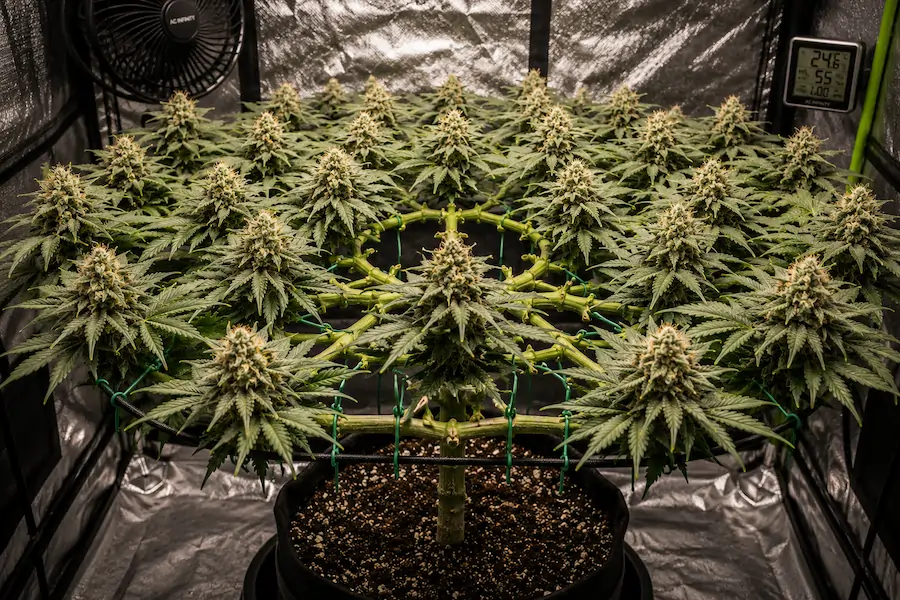
Flower multiplies existing structure.
It rarely fixes it.
Matty: “The manifold you enter flower with is basically the canopy you’ll harvest later.”
Mainlining vs Topping vs Super Cropping vs SCROG
Topping
Topping removes the dominant tip once.
Simple. Fast. Effective.
But the hierarchy naturally rebuilds itself afterward.
Super Cropping
Super cropping manipulates recovery through controlled stress.
It’s excellent for canopy control and branch strengthening.
But recovery quality becomes the hidden yield variable.
That’s why Part 1 of this series focused so heavily on post-stress momentum.
SCROG
SCROG controls horizontal canopy spread using a screen.
Excellent for light distribution and yield efficiency.
But it doesn’t inherently equalise vascular pressure the way mainlining does.
Mainlining
Mainlining is slower than all of them.
But it’s also the cleanest hormonal reset when done correctly.
Because every topping event redistributes dominance evenly from the same central hub.
Matty: “Super cropping manipulates recovery. Mainlining manipulates hierarchy.”
The Strains That Love Mainlining — And the Ones That Hate It
Some genetics thrive under manifold training.
Others fight it the entire way.
Excellent Mainlining Strains
- Bruce Banner Feminised Seeds
- Blue Dream Feminised Seeds
- Jack Herer Feminised Seeds
- Durban Poison Feminised Seeds
These strains recover aggressively, branch vigorously, and tolerate repeated redistribution stress extremely well.
Strains That Require Extra Precision
Dense, slower-recovering plants punish uneven recovery much harder during late vegetative development.
Autoflowers? Honestly… Be Careful.
Autos have limited recovery time.
That means topping mistakes compound extremely fast.
That’s why aggressive manifolding is usually a poor fit for:
Low-stress shaping works much better for most autos.
Matty: “Photoperiods forgive structure mistakes. Autos remember them forever.”
Environmental Drift Can Quietly Break a Manifold
Mainlining becomes extremely sensitive to uneven environmental pressure during recovery.
If one arm receives noticeably stronger light, dries faster, or recovers under warmer airflow conditions, hormonal balance shifts again almost immediately.
Even a roughly 10–15% PPFD difference between arms during post-topping recovery can begin creating dominance drift within 24–48 hours.
That’s why advanced mainlining isn’t just structural training.
It’s environmental consistency training too.
If you haven’t already, our humidity and airflow guide explains how stable recovery conditions directly affect high-stress training performance.
Final Verdict — What Mainlining Actually Is
Mainlining is not plant sculpture.
It’s controlled hierarchy management.
The growers who get elite results aren’t the ones building the prettiest manifolds.
They’re the ones maintaining equal biological pressure across the entire canopy for weeks at a time.
Because once one side quietly starts dominating again, the structure stops behaving like a true manifold — even if it still looks beautiful from above.
Matty’s Final Word: “You’re not building symmetry. You’re building equal pressure.”
Ready to apply it properly? Browse our feminised seed range — especially the vigorous photoperiod strains that reward advanced training techniques.
If you haven’t read it yet, Part 1 of the HST series on advanced super cropping explains the recovery mechanics that make advanced mainlining work properly in the first place.