
 AUS Stock - Local Delivery

Few things make a grower panic faster than spotting brown marks on otherwise healthy cannabis leaves.
One day everything looks dialled in. The next, you’re seeing rust spots, burnt edges, or patches creeping across the leaf surface.
Take a breath — most brown spotting is fixable. The real problem is that it’s often misdiagnosed.
It might be calcium. It might be pH lockout. It might be roots struggling or nutrients blocking each other. And those can all look surprisingly similar at first glance.
In this guide, I’ll show you how to read the pattern properly, trace it back to the real cause, and fix it without chasing the wrong solution.
— Matty
What Causes Brown Spots on Cannabis Leaves?
Brown spots on cannabis leaves are usually caused by nutrient imbalances, pH lockout, or root-zone stress.
- Calcium deficiency – rust-coloured spots on newer growth
- Potassium issues – burnt edges and patchy necrosis
- pH lockout – nutrients present but unavailable to the plant
- Nutrient antagonism – excess potassium or magnesium blocking calcium uptake
- Root stress – poor oxygen or overwatering limiting nutrient absorption
- Pests or pathogens – less common, but possible in certain environments
The key is not just spotting the damage, but identifying where it starts and how it spreads across the plant. If you’re unsure, compare the pattern against a visual nutrient deficiency guide to narrow down the cause quickly.
Are Brown Spots Always Calcium Deficiency?
No — and this is where many growers go wrong.
Calcium is a common cause of brown spotting, but it’s not the only one. Potassium imbalance, pH lockout, and root-zone stress can all produce similar symptoms.
If you treat every brown spot as a calcium issue, you can easily make things worse by adding nutrients the plant can’t use.
The key is to read where the damage starts and what the rest of the plant is doing before making changes.
Quick Diagnosis Cheat Sheet
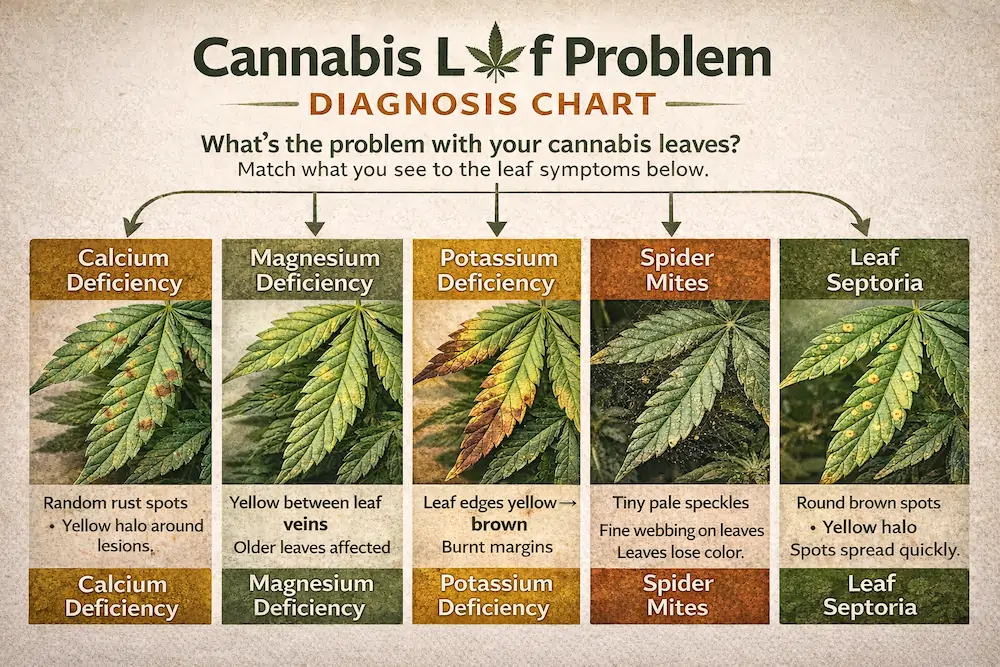
| Symptom | Most Likely Cause | Where It Appears |
|---|---|---|
| Random rust spots | Calcium deficiency | New leaves |
| Yellow between veins + brown spots | Magnesium deficiency | Older leaves |
| Crispy brown leaf edges | Potassium deficiency | Leaf margins |
| Speckled dots + webbing | Spider mites | Leaf underside |
| Round spots with yellow halo | Leaf septoria fungus | Throughout canopy |
| Multiple random symptoms | pH lockout | Whole plant |
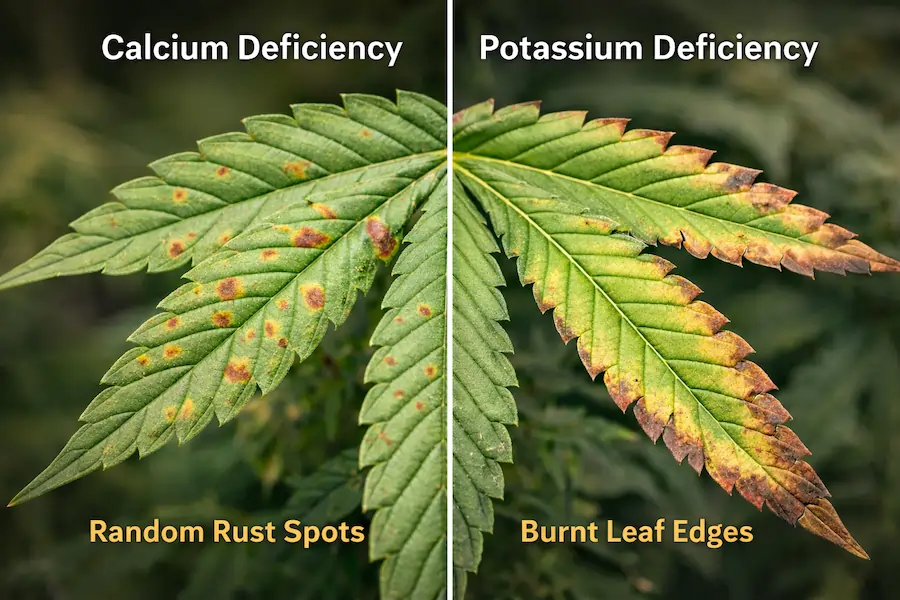
The Rust vs Burn Rule (Pro Grower Trick)
Growers often confuse Calcium deficiency with Potassium burn.
Here’s the difference:
- Calcium deficiency: random circular rust spots.
- Potassium deficiency: brown edges that follow the leaf margin.
If the damage starts on the edge of the leaf, think potassium.
If the damage appears randomly across the leaf surface, calcium is the more likely suspect.
The Mobile vs Immobile Nutrient Rule
Professional growers diagnose plant problems using a simple rule: mobility.
Some nutrients move through the plant. Others don’t.
- Calcium = immobile → new leaves show symptoms first
- Magnesium = mobile → older leaves show symptoms first
This one rule can solve half of your diagnosis problems in seconds.
If multiple symptoms show up at once, assume it’s a system problem — not five separate deficiencies.
1. Calcium Deficiency (Most Common Cause)
Calcium builds plant cell walls and supports new growth.
When cannabis can’t absorb enough calcium, the newest leaves are usually the first to show rust spots.
Typical symptoms:
- Rust spots on new leaves
- Twisted or distorted growth
- Leaf edges curling upward
Matty’s Cal-Mag Rule:
Calcium is a lazy nutrient.
It needs a soil pH above 6.2 to move properly.
If your soil pH is 5.8, adding more Cal-Mag won’t fix the problem.
Fix the gate (pH) before you hire more security (nutrients).
2. Magnesium Deficiency
Magnesium powers photosynthesis.
When plants lack magnesium, the tissue between veins turns yellow while veins stay green.
Brown spots often appear as the deficiency worsens.
Symptoms:
- Interveinal yellowing
- Brown spots forming later
- Older leaves affected first
Magnesium issues are common when pH drifts or potassium levels become too high.
3. Potassium Deficiency
Potassium regulates water movement and plant metabolism.
When potassium is lacking, the edges of leaves begin burning first.
Symptoms:
- Crispy brown leaf margins
- Weak stems
- Reduced bud development
Unlike calcium, potassium burn usually follows the outline of the leaf edge.
4. pH Lockout
pH lockout happens when nutrients exist in the soil but the plant can’t absorb them.
This causes multiple deficiency symptoms at the same time.
Ideal pH ranges:
- Soil: 6.0–7.0
- Hydro/Coco: 5.5–6.5
pH Swings (Hidden Hydro Problem)
In hydro systems, rapid pH swings can also trigger spotting.
If pH jumps between 5.5 and 6.8 within hours, nutrient uptake becomes unstable.
Stable pH is just as important as correct pH.
Matty’s Mini-Flush Protocol
Instead of blasting your medium with plain water, try a mini-flush:
- Run pH-balanced water with ¼-strength nutrients
- Allow about 20% runoff
- This resets the root zone without shocking the plant
Flushing with pure water alone can sometimes cause nutrient shock.
5. Spider Mites
Spider mites puncture leaf tissue and suck out plant juices.
Their feeding leaves behind tiny pale speckles that turn bronze or brown.
Check the underside of leaves for movement and webbing.
6. Leaf Septoria
Leaf septoria is a fungal disease that creates circular spots with yellow halos.
It spreads quickly in humid environments with poor airflow.
Remove infected leaves and improve ventilation immediately.
7. Overwatering
Overwatering suffocates roots and prevents nutrient uptake.
This often triggers secondary deficiencies that show up as spotting.
Matty’s watering rule:
If the pot still feels heavy, your watering can can wait.
Purple vs Pathogen (Important for Purple Genetics)
Growers running purple strains sometimes mistake healthy fading for disease.
Here’s the difference:
- Genetic purple: soft leaf texture, even coloration
- Necrotic brown spots: crispy and dead tissue
If the leaf is purple but still flexible, it’s usually genetic fade.
If it’s brown and brittle, something is wrong.
Natural Late-Flower Fade
In the final two weeks of flowering, some yellowing or spotting is normal.
This process is called senescence, the plant’s natural aging cycle.
Not every late-flower leaf issue needs a fix.
Real Lesson from Matty’s Grow Room
A grower once thought his plants had phosphorus deficiency because the leaves were turning dark brown-purple.
He started hammering them with bloom boosters.
The real problem?
His soil pH was 5.5.
Phosphorus and calcium were both locked out.
Once we corrected the pH to 6.5, the plant recovered and the leaves turned into a healthy purple fade instead of dying tissue.
Final Thoughts
Brown spots on cannabis leaves look scary, but most are simply diagnostic clues.
Once you learn to read them, plant problems become much easier to solve.
And remember — every experienced grower has stared at a leaf like this at some point.