
 AUS Stock - Local Delivery

Hydroponic cannabis doesn’t fail slowly.
That’s the difference.
In soil, growers can sometimes get away with sloppy feeding, inconsistent watering, and bad habits for weeks before the plant finally complains.
Hydro doesn’t give you that luxury.
The root zone reacts immediately.
Water temperature shifts.
EC drifts.
Oxygen drops.
pH swings.
The plant responds before you even realise you made the mistake.
I’ve watched growers run perfect veg for eight weeks and then lose the entire flower trajectory in less than a week because the reservoir quietly climbed past 25°C during an Australian heatwave.
That’s why hydro grows can produce explosive growth, extreme resin production, and heavyweight yields — or collapse faster than almost any other cultivation style.
Matty: “In hydro, the root zone decides before the canopy understands the problem.”
This isn’t just a beginner guide.
This is the real-world system behind hydroponic cannabis in Australian conditions — the stuff that actually determines whether your grow becomes elite or turns into a slimy root-zone disaster halfway through flower.
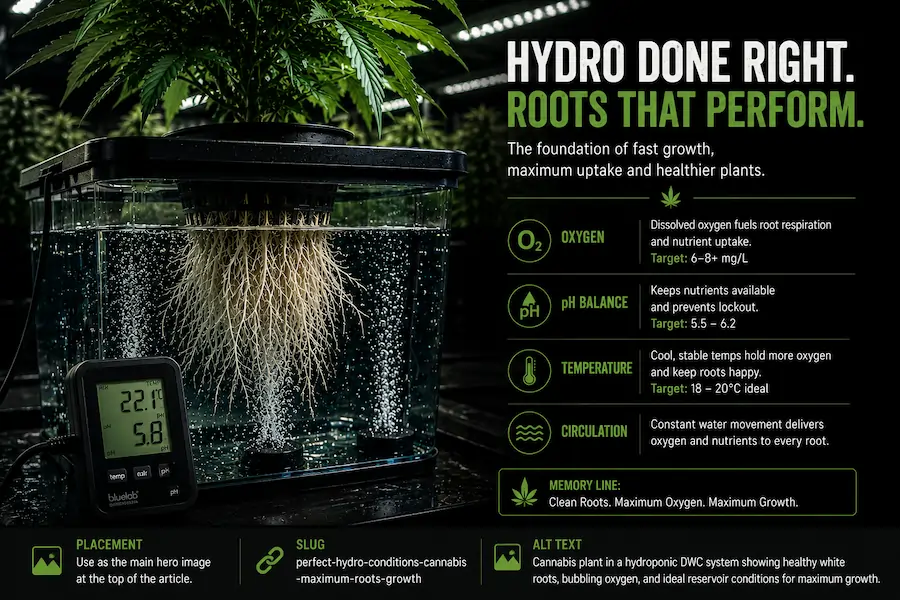
The Stabilising Truth: Hydro Is Oxygen First
Most growers think hydro is mainly about nutrients.
It isn’t.
Hydro is about oxygen first.
The nutrient solution only works properly when the roots stay oxygenated.
Once dissolved oxygen drops:
- water uptake slows,
- transpiration weakens,
- nutrient transport stalls,
- root pathogens begin multiplying.
And the dangerous part?
The leaves often still look fine early on.
This is why hydro failures feel confusing.
The canopy can appear healthy while the root zone is already collapsing underneath.
Matty: “By the time the leaves complain, the roots have already been drowning for days.”
The Hydro Illusion
“The plant looks huge, so the system must be working.”
That’s the trap.
Hydro can make plants look spectacular while the root zone is quietly losing control.
The leaves stay green.
The plant stretches hard.
The room looks alive.
But underneath, oxygen may already be dropping, EC may be concentrating, and uptake may already be slowing.
When root oxygen drops, cannabis often maintains visible leaf health temporarily through altered transpiration behaviour.
That delay is what creates the illusion.
The plant still looks successful while the exact system driving aggressive growth is already weakening underneath.
This creates the classic hydro false-success pattern:
- big canopy, weak transport,
- dark leaves, poor uptake,
- fast stretch, soft structure,
- visual swelling, weaker stacking pressure.
That’s why some hydro grows look incredible in veg but disappoint in flower.
The plant grew fast.
The system didn’t stay stable enough to finish strong.
Matty: “Hydro can make a plant look successful before it proves the roots were actually healthy.”
The Reservoir Heat Problem Behind Most Australian Hydro Failures
Australia is brutal on hydro systems.
Especially in garages, sheds, spare rooms, and tents during summer.
Warm reservoir temperatures are one of the fastest ways to destroy a hydro grow.
Once water temperatures climb above roughly 21–22°C:
- dissolved oxygen drops sharply,
- root respiration weakens,
- Pythium and root pathogens multiply faster,
- slime and rot can begin forming.
And once root rot truly establishes itself, recovery becomes difficult fast.
That’s why elite hydro growers obsess over water temperature more than nutrients.
Healthy roots create healthy plants.
Not the other way around.
| Reservoir Temperature | Risk Level | Matty’s Read |
|---|---|---|
| 18–20°C | Ideal | Strong oxygen, clean uptake, stable roots. |
| 21–22°C | Caution | Oxygen starts dropping fast. Watch closely. |
| 23°C+ | Danger | Pathogens accelerate and root rot risk spikes hard. |
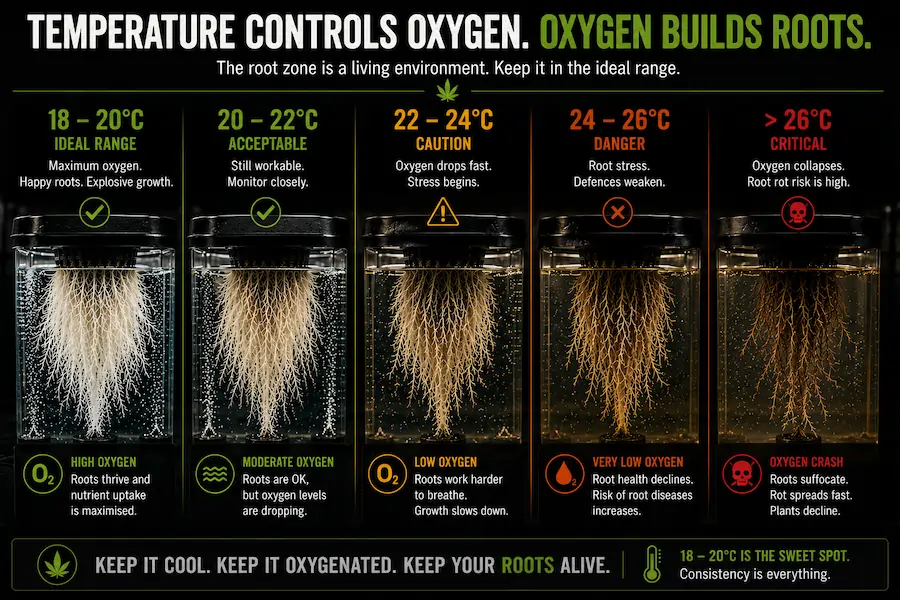
Matty: “Hot water turns hydro into soup.”
What pH Should Hydroponic Cannabis Be?
Hydroponic cannabis performs best when the root zone stays slightly acidic.
That’s because different nutrients become more or less available depending on pH.
If pH drifts too high or too low:
- nutrient uptake becomes inefficient,
- transport slows,
- deficiencies can appear even when nutrients are present.
| Hydro Stage | Recommended pH | Why It Matters |
|---|---|---|
| Vegetative Growth | 5.8–6.2 | Supports aggressive uptake and strong root expansion. |
| Early Flower | 5.8–6.1 | Keeps transport stable during stretch. |
| Late Flower | 5.5–5.8 | Helps phosphorus availability and finishing expression. |
Matty: “Hydro roots don’t need perfection. They need stability.”
The Hydro Myth That Keeps Ruining Beginners
“Hydro is complicated.”
Not really.
What’s complicated is inconsistency.
The growers who struggle most are usually the ones constantly changing:
- feed strength,
- additives,
- pH strategy,
- light intensity,
- watering timing.
Hydro punishes emotional growing.
The best runs usually look boring week-to-week.
Stable roots.
Stable temperatures.
Stable uptake.
Stable oxygen.
That’s what creates heavyweight flower.
Matty: “The best hydro rooms don’t feel dramatic. They feel predictable.”
The Root-Zone Stability Window
The best hydro growers don’t constantly “optimise.”
They stabilise.
Hydro roots hate violent swings.
Especially swings in:
- EC,
- pH,
- water temperature,
- oxygen availability.
As a general rule:
- EC swings greater than ~0.4 in 24 hours,
- pH swings greater than ~0.3,
- temperature swings greater than ~3°C per day
begin creating noticeable osmotic stress inside the root zone.
And osmotic stress interrupts growth momentum.
Sometimes permanently during flower.
This is why many hydro growers accidentally create huge-looking plants that still produce disappointing harvests.
The root zone never stayed stable long enough for the plant to maintain stacking pressure.
Matty: “Hydro plants don’t want more inputs. They want fewer surprises.”
What EC Should You Use for Hydroponic Cannabis?
One of the biggest beginner mistakes in hydro is chasing aggressive EC numbers too early.
Especially during transition and early flower.
Growers see fast growth and assume the plant wants maximum feed.
Sometimes the opposite is true.
High EC:
- slows water movement,
- raises osmotic pressure,
- reduces oxygen efficiency,
- creates salt accumulation.
In many hydro systems, EC above roughly 2.4 during peak flower begins reducing transport efficiency even when the leaves still look dark green.
That’s the trap.
Hydro lets you push harder.
It does not mean you should.
| Growth Stage | Typical EC Range | Matty’s Read |
|---|---|---|
| Seedling / Early Veg | 0.6–1.0 | Young roots want gentle uptake, not pressure. |
| Vegetative Growth | 1.0–1.4 | Push stability before aggression. |
| Early Flower | 1.4–2.0 | Stretch increases uptake demand fast. |
| Peak Flower | 1.8–2.4 | More feed is not always more density. |
| Late Flower | 1.0–1.4 | Let the plant finish cleanly. |
Matty: “Most hydro growers don’t underfeed. They overreact.”
Which Hydroponic System Is Best for Cannabis?
| Hydro System | Growth Speed | Australian Heat Risk | Recovery Buffer | Best For |
|---|---|---|---|---|
| DWC (Deep Water Culture) | Very Fast | High | Low | Growers with strong environmental control and reservoir cooling. |
| Drip Systems | Fast | Moderate | Moderate | Balanced hydro performance with better root-zone forgiveness. |
| Ebb & Flow | Fast | Moderate | High | Growers wanting hydro speed with stronger oxygen buffering. |
| Coco Hydro | Moderate–Fast | Lower | High | Beginners transitioning from soil into hydro-style feeding. |
Matty: “The faster the system grows, the less time you get to fix mistakes.”
The Hidden Root-Rot Warning Signs
Most growers wait for yellow leaves.
That’s too late.
Real hydro growers learn the earlier signals:
- the reservoir smell changes,
- the room stops drying back normally,
- the plant loses “praying” posture,
- growth speed suddenly plateaus,
- leaf posture becomes softer or heavier,
- water uptake slows despite healthy lighting.

Those are root-zone warnings.
Not leaf problems.
And if you miss them, the damage compounds fast.
Matty: “Healthy roots make the whole room feel alive. Sick roots make the room go quiet.”
The Stretch Window Most Hydro Growers Ruin
Hydro plants stretch aggressively during the first 10–14 days after flip.
And this is where weak airflow systems usually collapse.
Leaf surface area explodes.
Humidity rises inside the canopy.
Transpiration pressure changes.
Suddenly, the airflow setup that worked in veg is no longer strong enough.
The result:
- stagnant microclimates,
- weak branch development,
- soft cell structure,
- future density problems.
This is why elite hydro growers constantly adjust airflow during stretch.
Not because they’re chasing comfort.
Because they’re protecting transpiration momentum.
Emergency Root-Zone Recovery Protocols
Hydro problems move underground first.
If the canopy is already screaming, you’re late.
Use this section like triage:
signal → meaning → move.
Matty: “Hydro problems move underground first. If the leaves are screaming, you’re late.”
Signal: Reservoir Temperature Climbs Above 23°C
What it means: dissolved oxygen is collapsing and root pathogens can accelerate fast.
Matty’s move: rotate frozen 2-litre water bottles into the reservoir every few hours until temperatures return to roughly 18–20°C. Increase aeration aggressively during the heat spike.
If you wait: roots begin suffocating before the leaves fully show stress. Once slime appears, recovery becomes dramatically harder.
Matty: “Hot water turns hydro into soup.”
Signal: EC Keeps Rising While the Plant Stops Drinking
What it means: the plant is no longer transporting water efficiently while salts continue concentrating.
Matty’s move: reduce feed strength by roughly 30%, stabilise pH, maintain oxygenation, and watch for “praying” posture returning within 24 hours.
If you wait: stacking momentum, terpene development, and density quietly decline underneath otherwise healthy-looking foliage.
Matty: “If EC rises while drinking slows, the roots are waving the flag.”
Signal: Reservoir Smells Swampy or Sour
What it means: pathogens are already multiplying. Healthy hydro reservoirs smell neutral and clean.
Matty’s move: use hydrogen peroxide only as an emergency sterilisation move, following the product label and dilution guidance exactly. Then lower water temperature, increase oxygenation, inspect roots directly, and remove slime buildup if present.
If you wait: root tips begin dying off and nutrient transport efficiency collapses quickly.
Matty: “Once it smells like a swamp, you’re not preventing root rot — you’re just deciding how bad it gets.”
Signal: The Room Suddenly Stops Drying Back Normally
What it means: transpiration pressure has weakened.
Matty’s move: inspect the entire chain — reservoir temperature, EC drift, root colour, oxygenation, and airflow.
If you wait: flower stacking can slow internally while the plant continues swelling visually.
Matty: “When the room stops breathing properly, the plants usually already have.”
Late-Finish pH Steering Without Causing Lockout
Every grower wants colour late in flower.
Most growers chase it badly.
The mistake is forcing aggressive nutrient stress or dramatic flushing too early.
That usually creates:
- yellow collapse,
- necrosis,
- transport failure,
- flat terpene expression.
During the final 10–14 days, allow pH to drift toward the lower side of the hydro range — roughly 5.5–5.7.
This helps maintain phosphorus availability while the plant naturally slows metabolism during finishing.
If the genetics carry anthocyanin potential, this often allows cleaner colour expression without destabilising the root zone.
Matty: “Real finish colour looks alive. Fake finish colour looks exhausted.”
Best Cannabis Strains for Hydroponics
| Strain | Why It Works in Hydro | Matty’s Note |
|---|---|---|
| White Widow | Handles oxygen-rich root zones well and recovers cleanly from training. | Reliable structure and forgiving enough for newer hydro growers. |
| Northern Lights | Stable growth pattern and manageable transpiration demand. | Good for growers wanting hydro speed without chaos. |
| Blue Dream | Explosive uptake and stretch can produce huge plants in dialled rooms. | Weak airflow gets exposed fast. |
| AK-47 | Responds strongly to stable EC and clean oxygen delivery. | Overfeeding dulls what makes it special. |
FAQs — Matty’s Take
Matty’s Final Word
Hydroponics is not magic.
It’s acceleration.
Everything happens faster:
- growth,
- uptake,
- mistakes,
- stress,
- recovery.
If your root zone stays cool, oxygenated, and stable, hydro becomes one of the most powerful cultivation systems on earth.
If the root zone turns chaotic, the plant records every mistake.
Hydro rewards growers who can run boring, predictable systems.
If your grow diary mostly says “changed nothing again today,” you’re probably doing it right.
Memory Line: “The leaves are just the scoreboard. The roots decide the game.”
Ready to build a stable hydro run?
Browse our full feminised cannabis seed collection and start with genetics that handle oxygen-rich root zones properly.