
 AUS Stock - Local Delivery

Your grow room can look perfect while your cannabis quietly stops performing properly.
That’s the trap.
The temperature looks stable.
The humidity looks correct.
The leaves still look healthy.
Nothing appears obviously wrong.
But inside the canopy, the plant has already started slowing down.
Not dying.
Not wilting.
Not crashing.
Just moving less aggressively.
And with cannabis, reduced movement changes everything:
- water transport slows
- nutrient movement weakens
- dry-backs lose rhythm
- recovery takes longer
- terpene pressure softens
- density formation loses momentum
The dangerous part?
Most growers don’t realise the slowdown started until weeks later, when the flower feels flatter, softer, or less alive than expected.
Matty: “I’ve watched rooms produce huge-looking plants that still disappointed at harvest because the canopy quietly stopped moving properly halfway through flower.”
The Stabilising Truth
Cannabis moves water through transpiration.
That means the plant relies on moisture evaporating from leaf surfaces to create the pressure that pulls water upward through the roots, stems, leaves, and flowers.
And airflow is what keeps that evaporation process active.
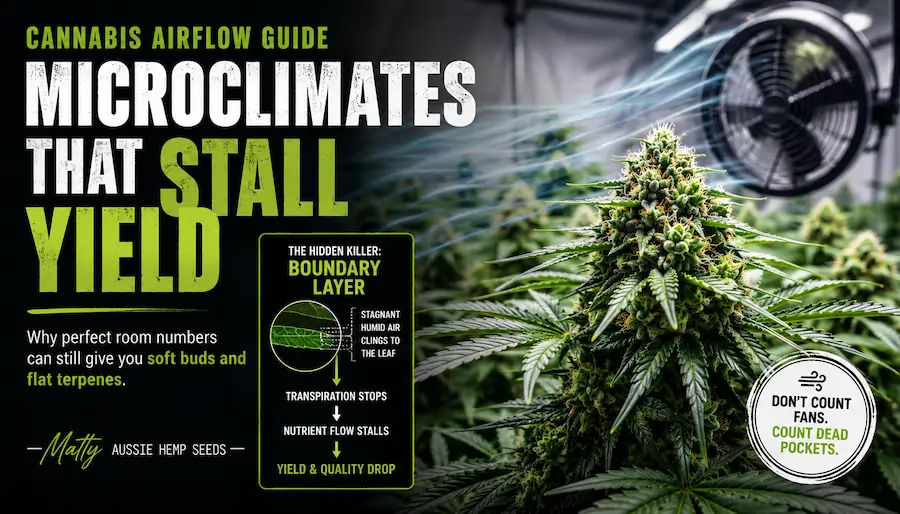
Every cannabis leaf creates a tiny layer of humid air around itself called the boundary layer.
When airflow is healthy:
- that humid air gets stripped away
- evaporation stays active
- transpiration remains strong
- water movement stays aggressive
When airflow weakens:
- humidity accumulates around the leaf surface
- evaporation slows
- transpiration pressure drops
- internal nutrient movement weakens
This is why airflow problems affect far more than mould prevention.
They change the entire internal transport system of the plant.
Matty: “Healthy cannabis needs movement. The second the canopy stops exchanging properly, quality starts drifting underneath the surface.”
The Myth
“If temperature and RH are correct, airflow is correct.”
Nope.
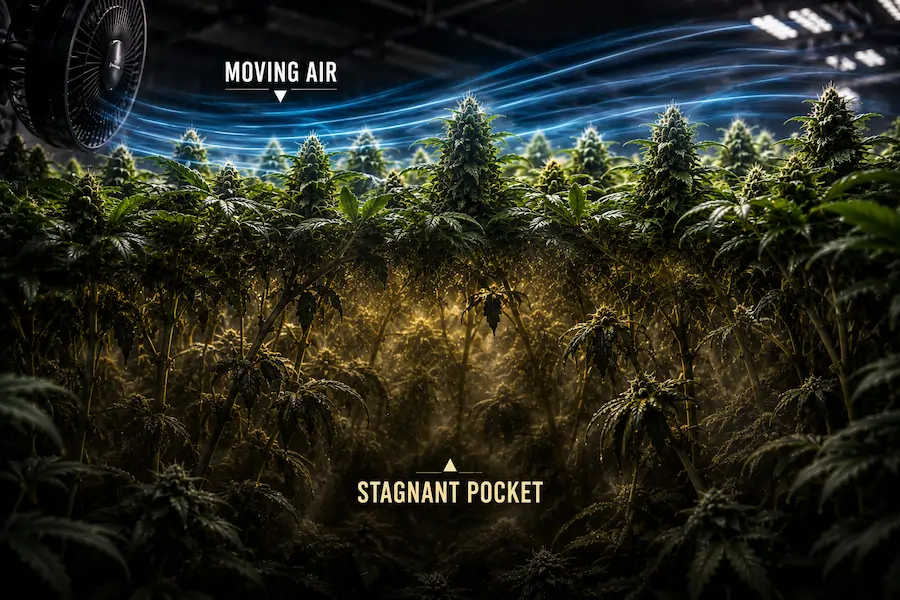
Because your room conditions are not your canopy conditions.
The sensor hanging on the wall does not tell you what is happening:
- inside dense buds
- under overlapping fan leaves
- deep in the lower canopy
- around crowded colas
- inside stagnant humidity pockets
Your grow room might read 24°C and 50% RH.
Meanwhile, the air inside a dense canopy can be much wetter, slower, and less active.
That is the hidden microclimate.
Once airflow weakens, cannabis starts trapping its own humidity around leaf surfaces and flower sites.
The wall sensor says “fine.”
The plant says “stuck.”
Matty: “Most airflow problems don’t happen in the room. They happen inside the plant’s own little weather system.”
The False Success
Bad airflow rarely looks like failure at first.
That is what makes it dangerous.
The leaves often stay green.
The buds keep swelling.
The room still smells strong.
The grower assumes everything is working.
But underneath that visual success, the plant’s internal movement has already slowed.
Weak airflow creates a false-success pattern:
- the canopy looks healthy
- the room numbers look acceptable
- the flowers continue expanding
- but dry-back slows, terpene precision drops, and density formation weakens
This is why poor airflow creates such deceptive harvests.
The plant does not always collapse.
It just finishes below its potential.
Matty: “Bad airflow doesn’t always ruin the plant. Sometimes it just quietly ruins what the plant could have been.”
How Does Poor Airflow Affect Cannabis Growth?
Poor airflow doesn’t just reduce air movement.
It changes the entire transport chain inside the plant.
Weak airflow → slower evaporation from leaves → reduced transpiration → slower water movement → weaker nutrient transport → slower recovery → reduced terpene pressure → softer density → flatter final flower.
That is the real airflow chain.
Not just fans.
Not just mould prevention.
Movement.
Once movement slows, the plant still grows visually, but quality begins drifting underneath the surface.
Matty: “Cannabis quality comes from movement. The second movement slows, quality starts slipping quietly.”
The Irreversible Moment
The most important airflow signal is not leaf movement.
It is dry-back rhythm.
If your room suddenly takes more than about 20% longer to dry back during peak flower, transpiration is already compromised.
That means the plant is no longer moving water with the same pressure it had before.
If that slowdown continues for 24–48 hours during a critical stacking window, the plant may resume visible growth later — but the full density trajectory often does not return.
This is where growers get fooled.
The canopy recovers visually.
The flowers continue swelling.
But the internal pressure that was building density, resin sharpness, and recovery speed has already been interrupted.
Matty: “When the room stops drinking properly, the plant usually stopped moving properly first.”
How Do You Know If Cannabis Has an Airflow Problem?
Airflow problems are rarely dramatic early.
They usually show up as subtle changes in rhythm, smell, density, and recovery.
Signal 1: The room stops drying back properly.
A healthy flowering room drinks aggressively. If pots stay wet longer than usual or dry-backs suddenly stretch beyond your normal baseline, investigate airflow first.
Signal 2: The smell gets louder — but less sharp.
This is an elite-level diagnostic.
Healthy terpene pressure smells sharp, alive, separated, and directional.
Bad airflow often makes the room smell louder but muddier.
The aroma gets bigger.
The profile gets flatter.
Durban loses sharpness.
AK-47 loses crispness.
OG Kush loses fuel definition.
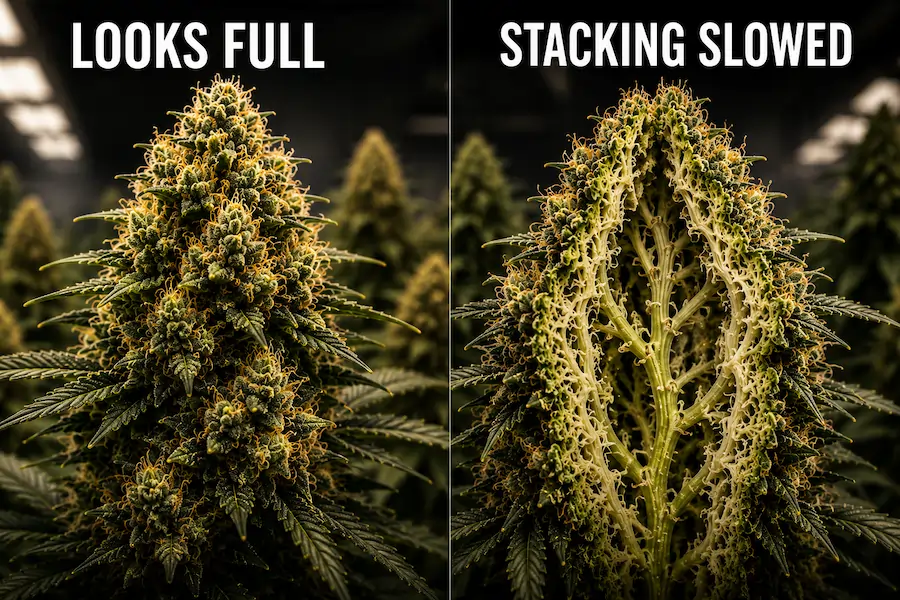
Signal 3: Buds swell — but don’t tighten.
The flowers keep expanding visually, but they stop compressing properly.
This happens because weaker transpiration reduces internal stacking pressure.
The buds look good in photos, then feel strangely soft at harvest.
Signal 4: Recovery starts taking longer.
Healthy cannabis recovers quickly after watering, pruning, training, heat, and small environmental swings.
Poor airflow slows that recovery loop.
The room feels stuck.
Not dead.
Just slow.
Matty: “Bad airflow usually shows up in the squish test long before it shows up in the leaves.”
How Much Airflow Does a Cannabis Grow Room Need?
You do not need hurricane-force wind.
You need constant exchange.
A good airflow setup should create gentle movement across the canopy, through the canopy, and underneath the canopy.
As a practical check:
- no movement = too little airflow
- gentle leaf movement = healthy airflow
- leaves twisting, folding, or holding a strong angle = too much direct wind
If leaves are being pushed hard enough to stay bent or stressed, the fan is too direct.
If lower leaves never move at all, the room has dead pockets.
The goal is not wind.
The goal is exchange.
Matty: “You’re not trying to beat the plant with air. You’re trying to stop the room from going stale.”
Best Fan Placement for Cannabis
Good fan placement creates layers of movement.
You want air moving:
- above the canopy
- across the tops
- through the middle
- under the lower branches
- out of the grow space
The common mistake is placing fans so they only move air above the canopy.
That makes the room feel active while the plant interior stays stagnant.
A strong setup usually includes:
- one fan moving air across the top canopy
- one fan moving air through or below the canopy
- extraction that removes humid air instead of recycling it endlessly
In dense flower rooms, the lower fan often matters more than growers realise.
That is where humidity sits.
That is where weak airflow starts.
Matty: “If air only moves above the plant, the room feels busy while the canopy stays lazy.”
How Many Fans Do You Need in a Cannabis Grow Room?
There is no universal number, but there is a useful rule:
You need enough fans to eliminate dead pockets without blasting the plants.
Start by checking the room, not counting hardware.
Put your hand inside the lower canopy.
Feel behind dense branches.
Check the corners.
Check beneath the canopy after lights have been on for a few hours.
If the air feels heavy, warm, or still in any of those spots, the room needs better movement there.
For larger rooms, SCROG setups, or dense indica-heavy canopies, fan count matters less than airflow coverage.
One fan might be enough for an open-structured sativa with wide spacing between branches.
Four fans can still fail in a dense room if they only move air across the top.
Matty: “Don’t count fans. Count dead pockets.”
Cannabis Humidity Targets by Stage
Humidity targets matter, but they only work when airflow supports them.
A room can hit the correct RH number and still have wet, stagnant canopy pockets.
| Growth Stage | Typical RH Range | Airflow Priority |
|---|---|---|
| Seedling | 60–70% | Gentle air exchange, no direct blasting. |
| Vegetative Growth | 55–65% | Build movement through the plant as leaf mass expands. |
| Early Flower | 45–55% | Prevent stretch from creating stagnant interior zones. |
| Late Flower | 40–50% | Protect dense buds from trapped internal humidity. |
If canopy RH is more than about 5–8% higher than room RH, boundary-layer buildup is already affecting transpiration.
That is when airflow needs adjusting.
Matty: “The number on the wall only matters if the plant is feeling the same number inside the canopy.”
Dense Strains vs Open Strains
Not all cannabis reacts to airflow problems the same way.
Dense canopy strains trap humidity internally and need stronger through-canopy airflow.
Examples include:
These strains are more likely to:
- soften internally
- lose density
- trap mould
- flatten terpenes
- stall stacking momentum
Open sativa structures usually let air move more easily.
Examples include:
These plants may tolerate airflow problems better structurally, but they still suffer physiologically.
Instead of density loss, they often show:
- reduced sharpness
- flatter terpene profiles
- weaker recovery
- less energetic effects
Different architecture.
Same hidden slowdown.
The Resin Trap
Late flower creates a dangerous illusion.
The room smells incredible.
Resin production looks strong.
Everything appears frosty.
But dense colas create their own humidity systems.
This is why some buds:
- rot from the inside
- lose sharpness late
- feel damp internally
- cure poorly
- smell flatter after drying
The outside of the cola tells one story.
The inside tells another.
Matty: “Big buds don’t fail from the outside in. They fail from the inside out.”
What Is VPD in Cannabis Airflow?
VPD stands for vapour pressure deficit.
It measures the atmosphere’s power to pull moisture out of the plant.
But here is the mechanical trap:
VPD only works if the air is actually moving.
Your wall sensor might display a clean peak-flower environment around 1.2–1.3 kPa.
But inside a dense pocket of overlapping fan leaves, the air can become stagnant and saturated.
That local microclimate can drop toward a suffocating 0.3–0.4 kPa.
At that point, the vapour pressure difference between the inside of the leaf and the surrounding air collapses.
The plant’s stomata cannot vent moisture efficiently.
The hydraulic pump drops into neutral.
Water movement slows.
Nutrient transport weakens.
Calcium movement into fast-growing flower tissue can collapse.
And the wall sensor may still look perfect.
That is why airflow and VPD must work together.
VPD gives you the pressure target.
Airflow lets the plant actually use it.
Matty: “A wall sensor showing perfect VPD in a room with dead pockets is like looking at a fuel gauge while your engine is missing its spark plugs.”
FAQs — Matty’s Take
Matty’s Final Word
This article is not really about fans.
It is about movement.
Good airflow keeps cannabis physiologically awake.
It strips away stagnant humidity, protects transpiration pressure, supports recovery speed, and helps the plant keep building density and terpene precision.
Bad airflow rarely announces itself loudly.
The room still looks healthy.
The buds still swell.
The harvest still happens.
But the flower often finishes softer, flatter, and less precise than it should have been.
Memory Line: “The best grow rooms don’t just feed cannabis well. They keep it moving.”
Ready to build a room that actually supports the plant instead of just looking good on the sensor?
Browse our feminised cannabis seeds and start with genetics matched to your grow environment.