
 AUS Stock - Local Delivery

HST Series Part 3 — Dynamic Canopy Steering During Flower Stretch
You flatten the canopy in Week 4 flower.
The tops look perfect afterward.
The room still feels healthy. Leaves stay green. Nothing snaps. Nothing crashes. The canopy even looks cleaner than before.
So you assume the training worked.
Then two weeks later, something feels… quieter.
The plant stops drinking as aggressively. Lower sites lose urgency. Bud stacking softens. The room never fully explodes the way it looked like it would during early stretch.
You still harvest decent flower.
But the canopy never quite finishes with the pressure it promised.
That’s the part most cannabis stretch control guides never explain.
The dangerous mistakes during flower stretch usually don’t look dramatic.
They look controlled.
And that’s exactly why growers keep making them.
Stabilising truth: the flowering stretch isn’t vertical growth. It’s the plant making its final structural decisions.
And once those decisions are made, the plant stops negotiating architecture entirely.
The mistake wasn’t the bend.
The mistake was thinking the plant was still listening.
The myth: “If I can still flatten the canopy, I can still fix the stretch.”
The reality: once the handover begins, physical corrections stop building structure and start taxing momentum instead.
The Stretch Phase Is the Plant Writing Its Production Contract
Most growers treat flower stretch like random vertical chaos.
Plant gets taller. Canopy gets messy. You flatten it back down. Simple.
Except biologically, that’s not what’s happening at all.
The stretch phase is the single most aggressive structural allocation window in the entire grow cycle.
This is when the plant decides:
- which tops deserve dominance
- where vascular pressure will concentrate
- how aggressively lower sites will compete
- how light gets distributed through the canopy
- which flower sites become premium production zones
That’s why stretch momentum matters so much.
The plant isn’t just “getting taller”.
It’s building the final highway system that feeds the entire flowering run.
And once that highway system stabilises, correction becomes expensive.
Matty: “The stretch phase is the plant deciding where final production pressure will live.”
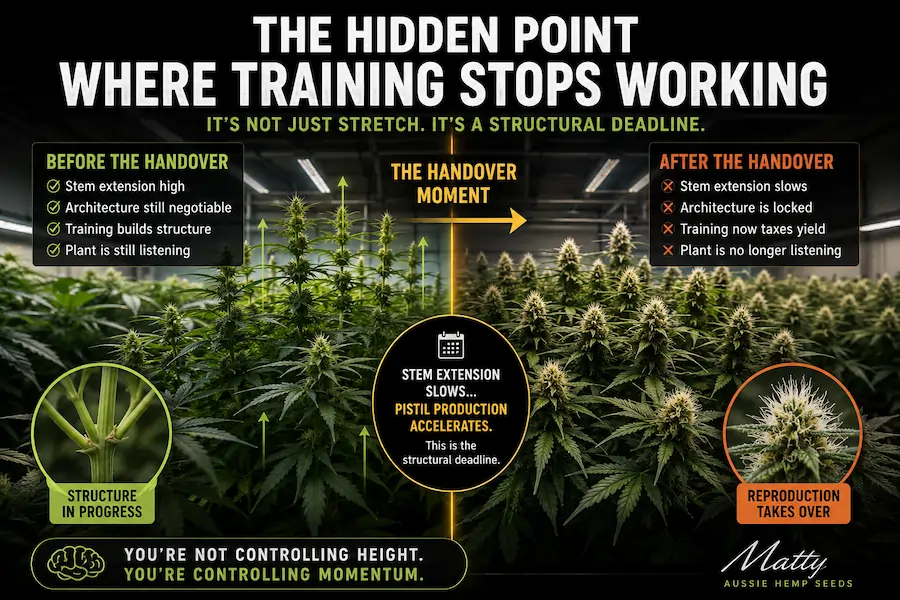
The Plant Stopped Listening
This is the handover almost every grower misses.
And once you see it properly, you’ll never look at flower stretch the same way again.
The transition happens here:
Stem extension slows… but pistil production accelerates.
That’s the real structural deadline.
Before this point, the plant is still negotiating architecture.
After this point, the plant shifts into reproductive efficiency.
That means:
- late topping becomes recovery taxation
- hard super cropping creates structural confusion
- heavy stripping interrupts vascular efficiency
- late “corrections” start costing momentum instead of improving structure
This is why emergency late-flower training so often creates “good but flat” harvests.
The canopy still looks organised.
But internally, the plant already stopped allocating energy toward rebuilding structure aggressively.
Now it’s trying to finish.
And every interruption after that point costs more than growers think.
Matty: “Late flower mistakes rarely look dramatic. They look slightly quieter every day afterward.”
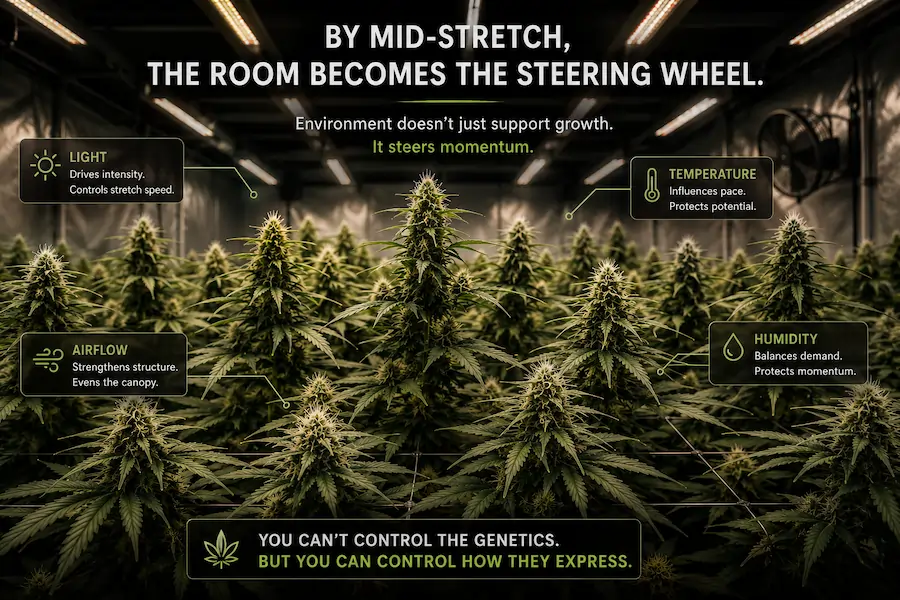
You’re Not Steering Branches Anymore — You’re Steering Pressure
Early veg training is physical.
Late flower steering is environmental.
That’s the shift most growers never fully make.
By mid-stretch, the room itself becomes the steering wheel.
This is where:
- PPFD shapes vertical aggression
- DLI controls production pressure
- leaf-surface temperature affects transpiration speed
- airflow changes canopy competition
- humidity stability controls recovery efficiency
Most growers still try to steer late flower with their hands.
The best rooms steer it with pressure instead.
A 15–20% PPFD adjustment during unstable stretch can soften vertical aggression without physically interrupting flower-site momentum.
Leave weak airflow pockets during heavy stretch and dominant tops monopolise transpiration faster than the lowers can compete.
Even slight canopy temperature differences start changing how aggressively tops chase the light.
That’s why identical genetics can finish completely differently in two rooms that “look” similar.
One room maintained momentum.
The other interrupted it quietly.
Matty: “The room stopped waiting for your hands around Week 3 of flower. Most growers just don’t know it yet.”
How Do You Control Cannabis Stretch Without Hurting Yield?
The safest way to control cannabis stretch is by steering environment before using physical stress late in flower.
- Reduce excessive PPFD gradually instead of crushing tops late
- Maintain strong, even airflow across the entire canopy
- Keep light distribution consistent during peak stretch
- Avoid heavy stripping once pistil acceleration begins
- Use SCROG resistance early instead of emergency bending late
The goal isn’t stopping height completely.
The goal is protecting structural momentum while flower sites finish developing.
SCROG Nets Aren’t Support Systems
This is one of the biggest misunderstandings in modern cannabis growing.
A SCROG net isn’t there to hold buds up.
That’s just the visible side effect.
A properly used SCROG net is controlled resistance.
The net pushes back against vertical dominance.
That resistance changes:
- auxin distribution
- branch pressure
- light competition
- stretch aggression
- lateral commitment
The reason this works is simple:
Equal resistance prevents one top from gaining the height advantage needed to monopolise hormonal priority.
That’s why good SCROG growers don’t just “fill squares”.
They create even resistance across the canopy.
Done properly, the canopy stops behaving like individual branches.
It starts behaving like one coordinated surface.
Matty: “A SCROG net isn’t support. It’s controlled resistance.”
Healthy Momentum vs Structural Collapse
Healthy Stretch Momentum
- tops pray aggressively after lights-on
- daily stem extension stays consistent
- drinking increases steadily during stretch
- lower sites continue chasing canopy height
- leaf posture stays active and competitive
- the room feels hungry every day
Structural Momentum Collapse
- canopy stays visually flat but energy softens
- drinking plateaus too early
- tops stop reaching aggressively
- lower sites stop competing upward
- pistil production accelerates before structure fully finishes building
- flower stacking begins before the canopy finishes expanding properly
If the room feels quieter for 3–4 consecutive days during active stretch, structural momentum has usually already shifted.
At that point, environmental correction is far safer than heavy physical intervention.
This is the dangerous part:
Nothing necessarily looks “wrong”.
The room still appears healthy.
Which is exactly why growers miss it.
Matty: “The dangerous canopies aren’t the wild ones. They’re the quiet flat ones that stopped fighting upward.”
Which Strains Punish Late Stretch Steering?
Excellent Stretch-Control Strains
Bruce Banner, Durban Poison, Super Lemon Haze, and Jack Herer respond extremely well to environmental canopy steering.
These strains stay structurally ambitious deep into stretch and reward aggressive momentum management.
High-Risk Dense Finishers
GG4, Gelato, Wedding Cake, and Godfather OG punish late interruptions hard.
These plants transition from structural growth into dense flower commitment quickly.
Late stress usually softens finish quality long before growers notice visible problems.
The Autoflower Danger Zone
GG4 Auto and Blue Dream Auto both demonstrate how quickly autoflowers stop negotiating structure once stretch momentum slows.
That’s why heavy late-flower steering on autos usually costs more production than it saves.

Final Verdict — What Stretch Control Actually Is
Most growers think flower stretch is about controlling height.
It isn’t.
It’s about protecting momentum while the plant finishes building its production engine.
That’s the real job.
Because once the plant stops negotiating structure, every interruption starts carrying a biological bill.
And the dangerous part?
The harvest usually doesn’t show you the mistake immediately.
The canopy already knew weeks earlier.
You’re not controlling height.
You’re controlling momentum.
The best growers eventually realise the canopy tells the truth long before the harvest does.
By the time flower quality drops, the plant already made that decision weeks earlier.
Ready to apply it properly?
Browse our feminised seed range — especially the strains that reward structural steering and aggressive stretch management.
If you haven’t read them yet, start with Part 1 of the HST Series on advanced super cropping and Part 2 of the HST Series on cannabis mainlining to understand recovery and hierarchy before you start steering momentum.